Affiliate link. As an Amazon Associate I earn from qualifying purchases. Shopping options: Browse adjustable under-sink organizers on Amazon
The best under-sink organizer is not the one with the most shelves—it is the one that fits around your plumbing and lets you reach what you use.
This guide explains the four organizer styles worth considering, who each style suits, and what to measure before buying.
The short answer
Under-sink storage is difficult because every cabinet is different. Drain pipes, garbage disposals, water lines, hinges, and the cabinet lip all reduce usable space. That is why measuring first matters more than choosing a popular model.
Compare the four useful styles
| Style | Works best when | Main tradeoff |
|---|---|---|
| L-shaped pull-out | Plumbing occupies the center or upper rear of the cabinet | Drawer travel needs clear space at the front |
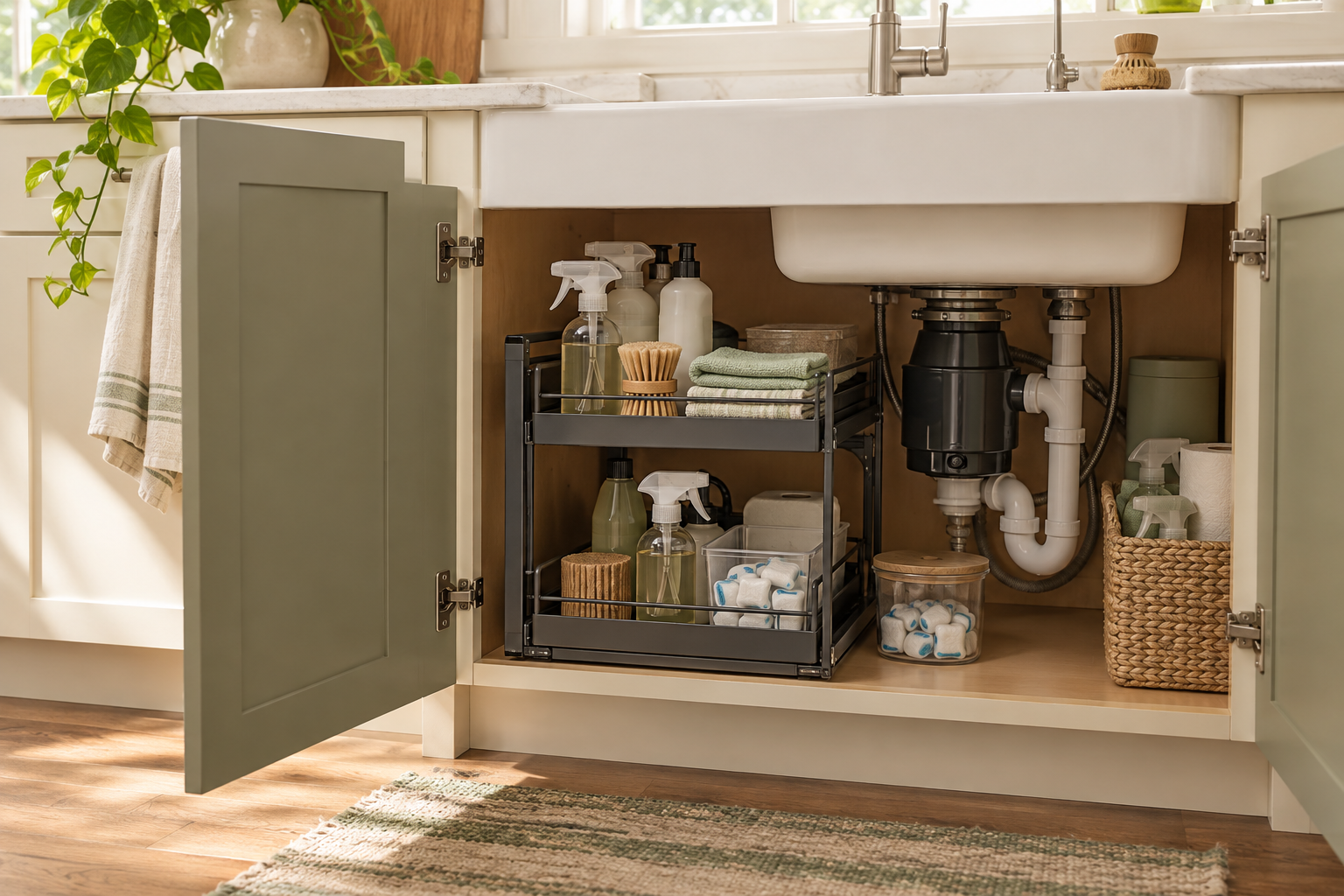
| Two-tier sliding drawer | You want fast access to bottles stored at the back | Tall bottles may not fit on the lower tier |
| Expandable shelf | The cabinet is wide and pipes pass through the shelving area | Small items need separate bins |
| Turntable or portable bin | You rent, move items often, or have a compact bathroom vanity | Uses vertical space less efficiently |
Our design-based picks
L-shaped pull-out organizers
An L-shaped frame keeps one upper side open for drain pipes while using the lower level for bottles and refills. This is usually the most forgiving layout when a P-trap or disposal blocks the center of the cabinet.
Good access to deep cabinets; open upper section avoids common pipe conflicts.
Check which side is open, drawer width, usable height, and whether cabinet hinges block the slide.
Two-tier organizers with sliding drawers
These create vertical storage and bring back-row supplies forward. Current editorial roundups from HGTV and The Kitchn include several variations of this format, which suggests it remains a common solution for both kitchens and bathrooms.
Easy to see and retrieve smaller supplies; often assembles without permanent mounting.
Measure spray-bottle height. A fixed upper basket can make the lower shelf too short.
Expandable shelving around pipes
Expandable systems use movable panels to bridge the cabinet while leaving gaps for plumbing. They work well when the cabinet is wide and you want a shelf rather than a drawer.
Width adjusts to the cabinet; movable panels accommodate unusual pipe positions.
Loose bottles can be awkward on narrow shelf panels, so add handled bins for small items.
Turntables and handled bins
A turntable is useful for small bottles that otherwise disappear at the back. Handled bins are even simpler: group supplies by task, then lift out the entire bin. Both options are renter-friendly and easy to clean.
No installation and easy to move between rooms.
A turntable needs clear circular space; a deep bin can hide short items unless they are grouped carefully.
Measure these five things first
- Inside width: measure between hinges, not only between cabinet walls.
- Usable depth: measure from the closed door to the rear wall or pipe.
- Clear height: measure below pipes and beside the sink basin.
- Plumbing footprint: note where pipes, valves, hoses, and disposal parts sit.
- Cabinet lip: a raised frame at the bottom can stop a drawer from sliding out.
What we would avoid
Avoid buying from the outside dimensions alone. Product listings may quote the overall frame size but not the usable clearance between tiers. Also be cautious with unsupported weight claims, very narrow pull-out tracks, and organizers that require permanent mounting when you cannot easily reach the cabinet floor.
A simple setup that stays organized
Store everyday cleaners at the front or in the pull-out section. Put refills and rarely used supplies higher or farther back. Keep leak-prone liquids inside a washable tray, and leave shutoff valves accessible. The organizer should make maintenance easier—not hide the plumbing completely.
Useful beats complicated.
Start by measuring the cabinet, then choose the simplest design that works around your plumbing.