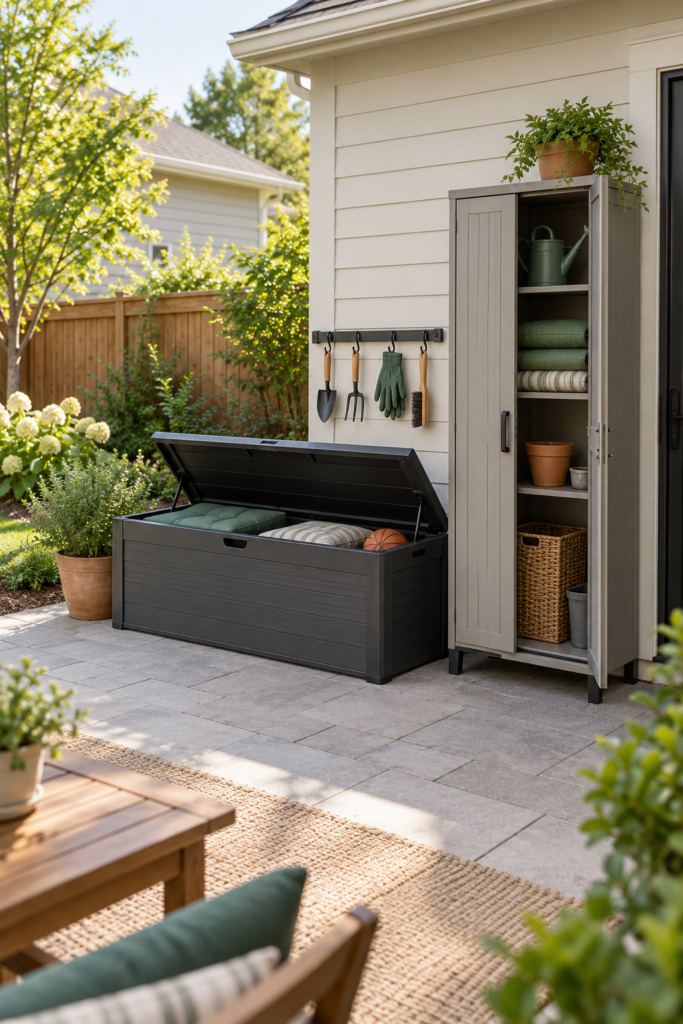
A small backyard does not always need more storage. It needs the right storage for the items that actually belong outside.
Before buying a large deck box or cabinet, list what you need to store, how often you use it, and how much protection each item requires. Then measure both the storage unit’s footprint and the clearance needed to open its lid or doors.
For many compact spaces, a narrow vertical cabinet, a properly rated storage bench, or several small storage zones can work better than one oversized container. The goal is not simply to hide clutter. It is to keep useful items dry enough, accessible, organized, and out of the walkway.
Start With What You Need to Store
Emptying the patio into one large box may create a different kind of clutter. Items at the bottom become difficult to reach, soft goods may trap moisture, and sharp or hazardous products can end up beside children’s toys.
Begin by grouping your items.
| Item group | Questions to ask |
|---|---|
| Seat cushions and outdoor textiles | Must they remain completely dry? Will they be stored only after drying? Do they need ventilation? |
| Small garden tools | Can sharp edges be separated and secured? Would hooks or a shallow bin make them easier to reach? |
| Long-handled tools | Is the cabinet tall enough internally? Can the doors open fully without blocking a path? |
| Children’s outdoor toys | Can children use the lid or door safely? Are hazardous items stored separately and out of reach? |
| Grill accessories | Are items cool and clean before storage? Does the grill manufacturer specify separate storage conditions? |
| Hoses and watering items | Can water drain before storage? Will the hose create a trip hazard while in use? |
| Chemicals, fuels, pesticides, and batteries | What do the original label and manufacturer instructions require? Should the item be stored somewhere else entirely? |
Some products should never be placed in a general-purpose deck box simply because they fit. The U.S. Environmental Protection Agency advises following the storage directions on product labels for potentially hazardous household products and keeping them in their original, labeled containers. That is a product-specific safety decision, not a general backyard-organization tip.
Sort by How Often You Use It
After grouping items, separate them by access frequency.
Daily or Weekly
Frequently used items should be visible or easy to reach without removing several other things. A shallow shelf, labeled bin, wall rail, or the front of a cabinet may be more useful than the bottom of a deep box.
Seasonal
Seasonal cushions, games, or garden accessories can sit farther back, but they still need a suitable environment. Label containers and inspect items before storing them for a long period.
Rarely Used
Ask whether the item belongs in the backyard at all. Removing, donating, recycling, or relocating unused items can solve the storage problem without adding another cabinet to a small space.
Nominal capacity does not guarantee useful capacity. A container can advertise a large volume while remaining awkward for long tools, divided items, or anything you need to retrieve frequently.
Measure Footprint and Opening Clearance
Storage dimensions usually describe the product while closed. Your patio must also accommodate the product while you are using it.
Measure:
- Exterior width, depth, and height.
- The full upward swing of a lid.
- The outward swing of one or two doors.
- Clearance below windows, railings, roof edges, or shelves.
- The walkway with the lid or doors fully open.
- The dimensions of the largest item you need to store.
- The narrowest useful interior dimension—not only the advertised capacity.
- The surface beneath the unit and the direction water moves across it.
Use painter’s tape to mark the closed footprint. Then mark the lid or door swing. Pull out nearby chairs, open the house door, move a trash bin, or walk through the area while the imaginary storage unit is “open.”
This test often reveals that a smaller box with better access is more useful than a larger one pressed against a wall.
1. Choose a Compact Deck Box for Flexible Storage
A compact deck box can hold cushions, games, small tools, or patio accessories when the product’s interior and weather guidance suit those items.
Compare more than capacity:
- Exterior footprint.
- Usable interior width and height.
- Lid swing and support mechanism.
- Drainage and ventilation.
- Handle and latch design.
- Whether a lock is included, optional, or only padlock-ready.
- Whether the top is approved for sitting—and the stated load limit if it is.
Do not call a box waterproof unless the manufacturer does. Even then, read the complete use and exposure guidance. Water may enter through an open lid, arrive from underneath, collect around the base, or be carried inside on wet items.
Best fit: Mixed, medium-size items in a location with enough lid clearance.
Main limitation: Deep boxes can become disorganized and difficult to access.
2. Use a Vertical Outdoor Cabinet for Long Tools
A vertical cabinet uses height instead of consuming a large area of patio. It may suit rakes, brooms, garden tools, watering accessories, and shelves of small items.
Look at exterior depth, interior depth, door opening, shelf compatibility, shelf load, floor design, foundation requirements, and anchoring instructions.
The difference between exterior and interior dimensions matters. As one example, Suncast lists one 22-cubic-foot vertical shed at approximately 32.25 inches wide, 25.5 inches deep, and 72 inches high outside, while its interior is approximately 27 inches wide, 20.25 inches deep, and 69 inches high. The manufacturer lists the door opening separately. Those measurements are more useful than the capacity number alone.
A tall unit also requires a stable, appropriate surface. Follow the manual for the exact model; do not assume every cabinet uses the same foundation or anchoring method.
Best fit: Long-handled tools and small items that benefit from shelves or hooks.
Main limitation: Door clearance, anchoring, and interior fittings may add space or cost.
3. Add a Storage Bench Only When It Is Rated for Seating
A storage bench can provide two functions in one footprint, which is valuable in a small patio. But a box that looks like a bench is not necessarily designed to support people.
Verify separately:
- Exterior footprint.
- Internal storage dimensions or capacity.
- Lid clearance and hinge design.
- Seat-load rating from the manufacturer.
- Weather and care instructions.
- Assembly requirements.
Never infer a seating load from the appearance, material, or customer photos. If the manufacturer does not state that the product is a seat, use it only for its stated purpose.
Best fit: A seating area that genuinely needs both functions.
Main limitation: Comfort, lid access, and seat rating can conflict with storage needs.
4. Move Small Tools Off the Floor With Rails or Hooks
A wall-mounted rail can keep hand tools, a lightweight hose, or small garden accessories visible and off the patio floor.
The wall, fasteners, rail, and hooks form one system. Check:
- The wall material and condition.
- The fasteners specified for that surface.
- The load rating of the rail and each hook.
- Whether the item could fall or swing into a walkway.
- Whether the location exposes tools to rain or heat.
- Whether drilling is allowed by the landlord, HOA, or property owner.
Do not hang heavy or sharp items above seating, play areas, or doors. Installation details should come from the product instructions and an appropriate professional where needed.
Best fit: Frequently used lightweight tools where a suitable wall is available.
Main limitation: Requires a safe mounting surface and disciplined weight limits.
5. Pair Narrow Shelving With Appropriate Bins
A narrow shelf can organize small items without the depth of a cabinet. It works best in a relatively protected area and when the shelf is designed for the environment.
Use bins sized to the shelf and label them by task rather than by vague categories. For example, “watering,” “small hand tools,” and “outdoor games” are easier to use than a box labeled “miscellaneous.”
Check shelf stability, anchoring guidance, per-shelf load, sunlight exposure, bin-lid design, and drainage. A lidded bin is not automatically waterproof, pest-proof, or appropriate for chemicals.
Best fit: Small items that need visual organization and frequent access.
Main limitation: Open shelving offers less weather protection and can look cluttered.
6. Use Suitable Space Under a Table or Counter
Space below an outdoor table or approved counter can hold one or two fitted bins without adding another large object.
Keep legroom and structural supports clear. Do not block access panels, utilities, drainage, or ventilation. Confirm that the bins fit when the furniture is in use and will not be kicked or pulled into the walkway.
This approach works better for light, frequently used items than for heavy equipment or hazardous materials.
Best fit: A covered or relatively protected seating or work area with unused lower space.
Main limitation: Limited weather protection and easy to overfill.
7. Try a Mobile Outdoor Cart
A cart can move gardening, serving, or project supplies between the storage area and the place where they are used.
Compare the overall footprint, handle clearance, wheel size, caster locks, load rating, shelf lips, weather suitability, and the surface over which the cart will travel. Small casters that work indoors may struggle with paver joints or uneven patios.
A cart still needs a safe home when not in use. Do not choose a mobile system if it will permanently occupy the main walkway.
Best fit: Supplies used in more than one backyard zone.
Main limitation: Wheels, uneven surfaces, and the need for a parking location.
8. Consider a Small Storage Shed or Locker
A narrow locker or shed may provide useful vertical capacity for long tools and bulky outdoor gear. It also introduces more requirements than a small box.
Check:
- Exact exterior and interior dimensions.
- Door opening and door-swing area.
- Required foundation or base.
- Anchoring instructions.
- Shelf and accessory compatibility.
- Roof drainage and location near the house.
- Local permit, setback, lease, or HOA requirements.
Suncast’s current product materials, for example, separate exterior size, interior size, door opening, and capacity for its vertical sheds. The company also publishes separate anchoring information. This illustrates why a shed should be evaluated as an installation, not simply as a tall container.
Best fit: Long tools or equipment that cannot fit into a low box.
Main limitation: Foundation, anchoring, door clearance, and property rules.
9. Create Small Storage Zones
One large container is not always the most space-efficient system. You might keep cushions near the seating area, hand tools near the garden bed, and toys near the play area.
Limit the number of zones. Each container adds a footprint and another surface to maintain. A good zone should reduce walking and make the correct storage action obvious.
Use consistent labels and review the contents seasonally. If every zone becomes a catch-all, consolidate or remove items before buying additional storage.
Best fit: A yard with two or three distinct activities.
Main limitation: Too many small containers can create more visual and physical clutter.
Weather-Resistant Is Not the Same as Waterproof
Outdoor-storage marketing uses several terms that are not interchangeable. Repeat the manufacturer’s exact wording and read the supporting instructions.
Ask:
- Is the unit described as water-resistant, weather-resistant, or waterproof?
- Does that statement apply to rain from above, wind-driven rain, or only the material itself?
- Does the base have openings or drainage paths?
- Must the unit sit on a level, solid surface?
- Does the manual require ventilation or seasonal indoor storage?
- Are the contents themselves suitable for an outdoor environment?
Dry cushions and textiles before closing them inside. Keep storage away from roof runoff and sprinkler spray where possible. Inspect the base after rain rather than assuming the interior is protected because the lid looks sealed.
Match the Storage to the Surface
Concrete or Pavers
Check flatness, joints, water pooling, and the base design. Pavers can settle unevenly and should not automatically be treated like structural concrete for anchoring.
Wood or Composite Deck
Consider load, trapped moisture, abrasion, ventilation, and any required attachment. Follow the storage product and deck manufacturers’ instructions.
Gravel
A cabinet or shed may need a prepared, level base rather than loose gravel. Use the model-specific manual.
Soil or Lawn
Direct ground contact can introduce moisture, settlement, corrosion, or rot. If the product requires a hard, level foundation, placing it directly on soil is not an acceptable shortcut.
Safety and Access
- Keep doors, gates, stairs, utility access, and exits clear.
- Follow instructions for anchoring tall storage units.
- Store heavy items low when the manual recommends it.
- Respect the load rating of every shelf, floor, lid, and seat.
- Keep sharp tools secure and away from children’s reach.
- Use lids and doors in a way that reduces finger-pinching risks.
- Do not sit, stand, or climb on a product unless it is designed for that use.
- Follow original labels for chemicals, pesticides, batteries, fuels, paints, cleaners, and oils.
EPA advises keeping potentially hazardous household products in their original containers, never mixing incompatible leftovers, and following label instructions for use, storage, and disposal. Check local environmental, health, solid-waste, or fire authorities when appropriate.
A Practical Product-Selection Checklist
| Criterion | What to verify |
|---|---|
| Exterior footprint | Assembled width, depth, and height |
| Interior fit | Usable internal dimensions and narrow points |
| Opening clearance | Lid height or full door-swing area |
| Material | Resin, metal, wood, composite, and frame components |
| Weather guidance | Exact manufacturer claim and limitations |
| Drainage and ventilation | Base, gaps, vents, inserts, and runoff path |
| Loads | Shelf, floor, lid, and seating ratings stated separately |
| Security | Latch, lock compatibility, and limitations |
| Assembly | Tools, people, base, anchoring, and accessories |
| Total value | Included parts and separately sold shelves, hooks, locks, or foundations |
Common Storage Mistakes
- Buying by capacity without measuring the longest item.
- Forgetting the lid or door clearance.
- Placing storage below roof runoff or direct sprinkler spray.
- Closing damp cushions inside a poorly ventilated box.
- Using a storage box as a bench without a manufacturer-rated seat load.
- Burying frequently used tools beneath seasonal items.
- Overloading a shelf or using the wrong mounting surface.
- Ignoring anchoring guidance for a tall cabinet.
- Storing hazardous products contrary to their labels.
- Buying more storage instead of removing things that are no longer used.
A Simple Three-Step Plan
- Edit the inventory. Remove items that do not belong outside or are no longer useful.
- Group by use and protection. Separate textiles, tools, toys, watering items, and products with special storage instructions.
- Choose the smallest workable system. Measure the product closed and open, then confirm the base, weather guidance, access, and installation.
Frequently Asked Questions
What is the best storage for a small backyard?
The best type depends on the items. A vertical cabinet may suit long tools, a compact deck box may suit medium-size accessories, and a rated storage bench may fit a seating area. Choose by interior fit, access, footprint, exposure, and the manufacturer’s instructions.
Can outdoor cushions stay in a deck box?
Only when the box and cushions are suitable for that use. Cushions should be dry before storage, and the box’s weather and ventilation guidance should be followed. Long-term or off-season storage may require a different location.
Is weather-resistant outdoor storage waterproof?
Not necessarily. Use the manufacturer’s exact claim and check the manual for rain exposure, drainage, base requirements, and limitations.
Can I use a deck box as a bench?
Only if the manufacturer says the product is designed for seating and provides an appropriate load rating. Appearance alone is not evidence that it is safe to sit on.
How do I store long-handled garden tools in a small space?
A narrow vertical cabinet, an appropriately installed wall rail, or a compatible tool rack may work. Measure the internal height, door opening, hook or shelf loads, and the surrounding clearance.
Do outdoor storage cabinets need to be anchored?
Some do. Height, design, surface, location, and model-specific instructions determine the requirement. Follow the exact manual rather than a general rule from another product.
Continue Planning Your Backyard
- If you need both seating and storage, compare outdoor storage benches for small patios.
- Check where folded pieces will go with our guide to folding patio furniture for small spaces.
- For cushions and small accessories near a table, start with the small outdoor bistro set guide.
Final Takeaway
The most useful outdoor storage system starts with an edited inventory, not a shopping list. Store frequently used items where they are easy to reach, measure the product both closed and open, and verify the manufacturer’s claims about weather, loads, foundation, and anchoring.
In a small backyard, access is part of capacity. A smaller unit that opens fully and keeps the right items organized can be more valuable than a larger box that blocks the walkway.