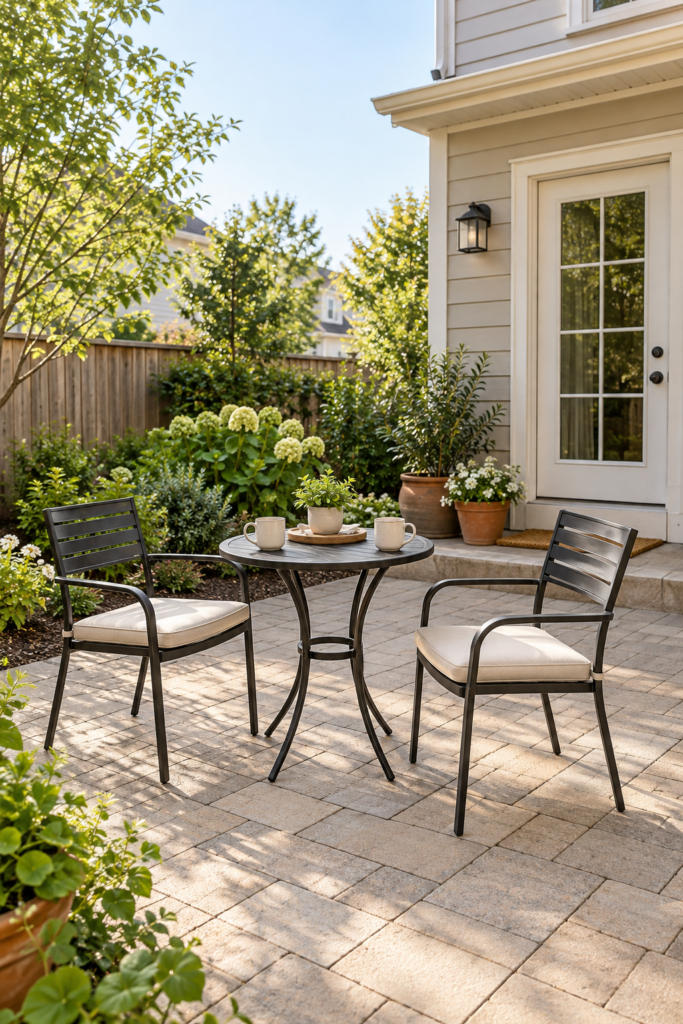
A small outdoor bistro set sounds simple: one table, two chairs, and very little space required. But a set that looks compact in a product photo can still block a door, crowd a walkway, or leave too little room to pull out a chair.
The most useful measurement is not the diameter of the tabletop. It is the working footprint of the entire set when two people are sitting down, moving their chairs, and walking around it.
Start with the activity you want the set to support. Then measure the space in its real operating condition. Compare comfort, stability, maintenance, and storage only after you know what can physically fit.
This guide explains that process without assuming one size, material, or style is right for every patio.
Quick Answer: What Should You Look for in a Small Bistro Set?
Before buying, check these seven things:
- Purpose: coffee, meals, working, reading, or occasional guests.
- Working footprint: table, chairs, seated people, chair movement, and walkway.
- Usable tabletop: enough room for what you actually plan to place on it.
- Chair comfort: seat dimensions, back support, armrests, and legroom.
- Stability: appropriate for the surface and conditions described by the manufacturer.
- Care and storage: cleaning, cushions, folding, covering, and seasonal storage.
- Delivery and assembly: packages must pass through the route to the patio.
A compact set is only space-saving if it remains comfortable enough to use and manageable enough to maintain.
Start With the Activity, Not the Furniture
Two people can use the same patio in very different ways. A table that works for morning coffee may be frustrating for dinner. A comfortable reading chair may be too deep for a narrow balcony.
Write down the activity you expect most often.
Coffee or Drinks for Two
A small round or square table may be enough for two mugs, a phone, and a small plate. Check whether both people can rest their arms naturally without crowding the center.
If the table will sit near a door, leave room for someone to remain seated while the other person passes.
Full Meals
Two place settings require more surface area than two drinks. Allow room for plates, glasses, utensils, serving items, and the objects you normally keep on the table.
Do not judge from a staged photograph. Decorations may hide how little usable surface remains.
Laptop Work
A laptop, notebook, mouse, drink, and charging arrangement can quickly fill a small tabletop. Consider glare, shade, seating posture, and whether outdoor power can be used safely. A café-style table that feels fine for 20 minutes may be uncomfortable for a longer work session.
Reading and Relaxing
If the table only holds a book and drink, chair comfort may matter more than table size. A deeper chair can improve comfort but also increase the working footprint.
Choose for the activity that happens every week, not the rare gathering you imagine once or twice a year.
Measure the Full Working Footprint
Retail listings usually give separate table and chair dimensions. Those numbers are necessary, but they do not show the total space required during use.
The full footprint includes:
- The width and depth of the table.
- The depth of both chairs.
- Space to pull the chairs away from the table.
- The seated person’s legs and body position.
- A route behind or beside the chairs.
- Door swings, steps, gates, planters, grills, and railings.
Draw the Patio and Mark Fixed Obstacles
Measure the usable floor, then mark everything that cannot move:
- Doors and their full swing.
- Windows that open outward.
- Steps and changes in level.
- Railings, posts, downspouts, and utility equipment.
- The route to a gate, storage area, or grill.
- Any drainage point that must remain clear.
Do not treat the entire patio as furniture space. A narrow route may be more important than an extra few inches of tabletop.
Mock Up the Set Before Buying
Use painter’s tape to mark the tabletop and chair positions on the floor. Place two existing chairs, boxes, or other movable objects inside the outline.
Then test the real movements:
- Open the exterior door completely.
- Pull each chair out and sit down.
- Walk past one seated person.
- Carry a tray from the door to the table.
- Reach the gate or storage area.
- Move the chairs to the position they will occupy when not in use.
Repeat the test at the widest configuration. If the set folds or expands, mark both its smallest and largest footprints.
Decide How Much Tabletop You Need
Small tables often save floor space by reducing usable surface. That is a reasonable tradeoff when it matches the activity.
Make a simple tabletop template from paper or cardboard using the advertised dimensions. Put the objects you expect to use on it. This reveals more than a product photograph.
Check for:
- Two plates without overlapping the edge.
- Glasses that are not crowded by a centerpiece.
- Space for shared food if you plan to serve it.
- A laptop and comfortable forearm position.
- Stable placement on slatted or textured surfaces.
A round table can feel socially comfortable for two people and avoids projecting corners. A square table may sit closer to a wall when not in use. A narrow rectangular table can follow a railing or wall but may provide less depth for place settings.
Shape changes how a table fits; it does not eliminate the need to measure the chairs around it.
Check Whether the Chairs Really Fit
The chairs determine much of the working footprint and comfort.
Seat Height and Table Height
Compare the manufacturer’s seat height with the table height. There must be enough space for thighs and knees without forcing the user into an awkward position.
A product photo can conceal a poor relationship between the chair and table, especially when components are sold separately.
Seat Width and Depth
Narrow chairs may save space but feel restrictive. Deep seats can be comfortable for lounging but require more room behind the table.
Check the published seat dimensions rather than the chair’s overall width alone. Armrests, frames, and curved backs can reduce the usable seating area.
Armrests or Armless Chairs
Armrests may make it easier to settle into the chair, but they can prevent the chair from sliding beneath the table. Armless chairs usually tuck in farther and may be easier to approach from the side.
Neither option is always better. The correct choice depends on comfort, mobility, and how the set must be stored.
Back Support and Sitting Time
A decorative metal chair may be acceptable for a short coffee but uncomfortable through a long meal. Compare the back height, shape, seat surface, and cushion requirements with the time you expect to sit.
If cushions are necessary, include their thickness, care, and storage in the decision. The set is not complete if the cushions have nowhere dry and convenient to go.
Can the Chairs Tuck Under the Table?
Compare the chair’s widest points with the clear space between the table legs and beneath the tabletop. A chair shown close to a table in a photograph may not actually slide under it.
The tuck-under position matters on a small patio because it determines the footprint when nobody is seated.
Compare Common Bistro-Set Layouts
Round Table With Two Chairs
Useful for: conversation, drinks, and compact corners without projecting table corners.
Check: full chair circle, table-base position, usable surface, and whether the set rocks on an uneven patio.
Square Table With Two Chairs
Useful for: placing one edge near a wall or railing when the set is not being used.
Check: corner clearance, leg placement, and whether two place settings fit without conflict.
Folding Table and Chairs
Useful for: a patio that must switch between seating and open floor space.
Check: folded dimensions, weight of each piece, locking mechanism, pinch points, carrying route, and storage location.
Folding furniture does not save space if it remains open because folding it is difficult or there is nowhere to store it. For a more detailed decision process, see our guide to folding patio furniture for small spaces.
Half-Round or Wall-Side Table
Useful for: extremely narrow locations where a full table would project too far.
Check: whether the product is freestanding or requires mounting, how two people approach it, and whether chairs still block the route.
Follow all installation instructions. Do not attach furniture to a wall, railing, or other structure unless the product and that structure are designed for it.
Balance Weight, Mobility, and Stability
Light furniture can be easy to rearrange or carry indoors. It can also move more easily when bumped or exposed to wind. Heavy furniture may feel more stable but can be difficult to deliver, assemble, or store.
Look for the manufacturer’s information about:
- Product weight for the table and each chair.
- Intended surface and outdoor use.
- Weight limits for seating.
- Leveling feet or adjustment instructions.
- Folding locks and moving instructions.
- Weather, wind, storage, or cover guidance.
Do not create your own anchoring method or add improvised weight unless the manufacturer allows it. A heavy object attached incorrectly can create a new hazard.
An uneven patio can make even a well-built table wobble. Follow the product instructions for adjustment, and do not use loose objects under a furniture leg as a permanent fix.
Compare Materials by the Care They Require
There is no maintenance-free material for every climate and location. Compare what you are willing to do throughout the year.
Powder-Coated Steel
Steel can provide weight and a slim frame. Check the coating, care instructions, exposed fasteners, drain openings, and the manufacturer’s process for damaged finishes. Inspect for corrosion rather than assuming the coating makes the set permanently rust-proof.
Aluminum
Aluminum is often lighter and resists rust in a different way than steel, but finishes, hardware, joints, and stability still matter. Confirm the actual product weight and care requirements.
Wood
Wood can feel warm and comfortable, but different species and finishes require different cleaning, drying, covering, or refinishing routines. Use the instructions for the exact product rather than a universal wood-care recipe.
Resin, Plastic, or HDPE
These terms cover many constructions. Check reinforcement, product weight, UV claims, temperature guidance, cleaning instructions, and replacement parts. Do not assume all plastic furniture performs the same way.
Woven or Wicker-Style Furniture
Inspect the frame beneath the woven surface, drainage, cushion requirements, cleaning instructions, and availability of replacement components. “All-weather” marketing still requires confirmation in the product documentation.
Plan for Rain, Sun, and Seasonal Storage
Outdoor furniture is designed for outdoor conditions only within the limits described by its manufacturer. Exposure, climate, drainage, covers, and maintenance affect how it performs.
Before buying, answer these questions:
- Will water drain away from the table and seats?
- Can the set dry with air circulating around it?
- Must cushions be brought inside after use?
- Is a cover recommended, and does it allow ventilation?
- Will the finish become hot in direct sun?
- Can the set stay outside all year in your conditions?
- Where will folded furniture go?
- Can one person safely move each piece?
A cover can reduce direct exposure, but it is not a substitute for the manufacturer’s storage and care instructions. Covering wet furniture may trap moisture.
If you need a place for cushions and accessories, plan it with our small backyard storage ideas rather than filling the remaining walkway with a box that was not included in the original layout.
Check Delivery Before You Order
A set can fit on the patio and still fail to reach it.
Check the packaged dimensions and weight, not only the assembled dimensions. Measure:
- Exterior and interior doors.
- Gate openings.
- Stair width and landings.
- Hallway corners.
- Elevators, if applicable.
- The narrowest point between the street and the final location.
Also review assembly requirements:
- Number of packages.
- Tools required.
- Number of people recommended.
- Assembly surface.
- Hardware and replacement-part process.
- Return rules if the set is too large or arrives damaged.
Do not plan to force a large assembled item through a tight opening or lift it over a railing.
Pair the Set With an Outdoor Rug or Umbrella Carefully
Accessories change the footprint.
An outdoor rug for a small patio must work with the chair movement, door clearance, drainage, and surface beneath it. Do not choose the rug size before the final furniture layout is known.
A small patio umbrella adds a canopy, pole, base, opening path, and wind limitations. The base may occupy valuable legroom or walkway space even when the canopy looks compact.
Add one accessory at a time to the taped floor plan. Recheck the route after every addition.
Small Outdoor Bistro Set Buying Checklist
- [ ] The primary activity is defined.
- [ ] The complete patio and all fixed obstacles are measured.
- [ ] The table and both chairs are mocked up in the in-use position.
- [ ] Each person can pull out a chair and sit comfortably.
- [ ] A practical walkway remains open.
- [ ] The door, gate, and storage route still work.
- [ ] The tabletop holds the objects required for the activity.
- [ ] Seat height, width, depth, and support are acceptable.
- [ ] Chairs tuck in as expected.
- [ ] Product weight and manufacturer limits are understood.
- [ ] Material care fits the available time and storage.
- [ ] Cushions have a dry, accessible location.
- [ ] Packages fit through the complete delivery route.
- [ ] Assembly and returns are manageable.
- [ ] Rug and umbrella footprints have been considered separately.
Common Mistakes to Avoid
Measuring Only the Table
The chairs and the people using them often take more space than the tabletop.
Buying for Occasional Guests
A four-seat set can make the patio less useful every day. Buy for regular use and consider separate folding chairs for rare visitors.
Trusting the Lifestyle Photo
Photography can distort scale and omit doors, walkways, and neighboring furniture. Use published dimensions and a physical mock-up.
Ignoring Chair Comfort
A tiny set that nobody wants to sit in is not a practical use of space.
Assuming Lightweight Means Better
Mobility is valuable, but weight also affects stability and the way furniture behaves when bumped or exposed to weather.
Forgetting Cushion Storage
Loose cushions can create a second purchase and another footprint problem.
Adding an Umbrella at the End
The base, pole, canopy, controls, and clearance should be included in the plan before ordering.
Choosing a Folding Set Without a Storage Plan
Measure the folded pieces and the route to their actual storage location.
Frequently Asked Questions
What size bistro set is best for a small patio?
There is no universal best size. Measure the complete working footprint with both chairs pulled out, two people seated, and the required walkway open. A small tabletop alone does not prove the set will fit.
Is a round or square bistro table better for a small space?
A round table avoids projecting corners and can feel comfortable for conversation. A square table may sit closer to a wall when not in use. The better option is the one that preserves chair movement, legroom, and the walking route in your layout.
Can two people eat dinner at a small bistro table?
Possibly, but test the advertised tabletop dimensions with two real place settings and anything else you normally serve. Some café tables suit drinks better than full meals.
Should bistro chairs have arms?
Armrests can support comfort and movement, but they use more width and may prevent a chair from sliding under the table. Compare both comfort and stored footprint.
Is folding patio furniture worth it?
It can be useful when the patio needs to become open space and the furniture can be folded, carried, and stored easily. It offers little benefit when the folding process is inconvenient or no suitable storage exists.
Can I leave a bistro set outside all year?
That depends on the exact materials, construction, finish, climate, exposure, and manufacturer instructions. Check the care and storage guidance for the specific set instead of relying on a general outdoor label.
Choose the Smallest Set That Supports Real Life
The right bistro set is not the one that occupies the fewest square inches in a product listing. It is the smallest set that comfortably supports what you want to do while keeping doors and walking routes usable.
Define the activity, measure the entire space, and mock up the working footprint. Check the chairs as carefully as the table. Then compare stability, materials, care, storage, delivery, and accessories.
That process may lead to a classic two-chair set, a folding arrangement, or a different furniture type altogether. The useful answer is the one that fits both the patio and the way you actually live.
For a broader comparison of bistro, folding, stackable, bench, and modular options, continue with our guide to patio furniture for small spaces.