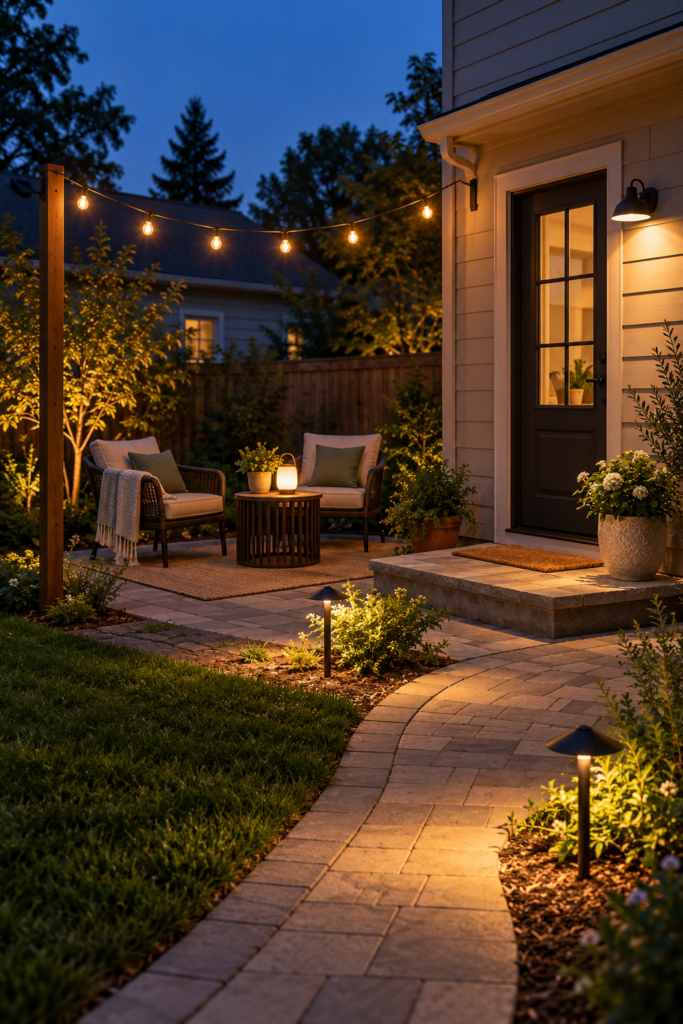
A cozy backyard does not need to be bright everywhere. It needs enough light in the right places.
Start with the door, steps, walking route, seating area, and any place where you prepare or serve food. Then add softer ambient light. Several controlled layers usually feel more comfortable than one powerful fixture trying to illuminate the entire yard.
Choose products specifically marked for the outdoor conditions where they will be used. Keep glare out of people’s eyes, neighboring windows, and the sky. Treat electricity, water, damaged cords, and permanent wiring as safety issues—not decorating details.
This guide will help you build a lighting plan and compare options. It does not replace the instructions for a specific product, local electrical requirements, or the judgment of a licensed electrician.
Map the Backyard Before Buying Lights
Walk through the backyard near dusk and make a simple sketch. Mark:
- The back door and its landing.
- Steps and changes in level.
- The main walking route.
- The dining or seating area.
- A grill or serving area.
- Gates and storage doors.
- Existing outdoor receptacles.
- Irrigation, downspouts, pools, spas, and other wet areas.
- Bedroom windows and neighboring property.
- Trees, walls, or planters you may want to accent.
Next, decide what must be visible for the space to function. A step needs different light than a dining table. A pathway needs different light than a tree used as a focal point.
If the seating layout is still undecided, plan its full working footprint first with our guide to patio furniture for small spaces. Lighting a table or chair arrangement is easier after the door swing and walking route are clear.
Do not begin by purchasing a decorative string-light set and looking for somewhere to put it. Begin with the tasks, then select the least amount of light that performs them comfortably.
Build Four Layers of Outdoor Light
A useful backyard lighting plan normally combines several layers.
1. Entry and Door Lighting
People need to see the landing, handle, lock, and immediate path near the door. A shielded fixture that directs light toward those surfaces can be more useful than a bright exposed bulb.
Check the fixture’s outdoor-use marking, intended mounting orientation, weather exposure, bulb limits, controls, and installation instructions. Fixed wiring and fixture replacement should be handled according to local requirements and by a qualified professional when appropriate.
2. Path and Step Lighting
Path lighting should reveal direction, edges, and changes in level without shining directly into people’s eyes.
Place light where the route turns or where the surface changes. Avoid a row of high-output fixtures that creates alternating pools of intense light and darkness. Low, shielded light can preserve visibility while keeping the yard calmer.
Step lighting should help the eye distinguish the tread and edge. Decorative lanterns that can be kicked, moved, or knocked over should not be the only way a critical step is marked.
3. Task Lighting
A grill, serving counter, or cleanup zone may need more focused light than the seating area. Aim task light at the work surface and keep it away from users’ eyes.
Follow the equipment manufacturer’s clearance guidance. Do not route cords near hot surfaces, sharp edges, standing water, or paths. If the task requires a new receptacle or fixed fixture, use a licensed electrician.
4. Ambient and Accent Lighting
Ambient light creates the relaxed atmosphere people often describe as cozy. String lights, table lanterns, wall washes, and a single highlighted tree can all contribute.
Add this layer after doors, routes, steps, and task surfaces are addressed. Ambient light should support the space rather than hide safety problems beneath a decorative glow.
9 Cozy Backyard Lighting Ideas
1. Use Shielded Downlights Near Doors
A fixture that contains the light and aims it downward can illuminate a landing without sending as much glare toward the seating area, nearby windows, or the sky.
Look at the fixture from the normal approach direction. If the lamp or bright LED source is directly visible and uncomfortable, a more shielded design or different aiming may work better.
2. Add Low Path Lights Where the Route Changes
Instead of lighting every foot of a path equally, concentrate on turns, edges, gates, and transitions between surfaces.
The goal is to read the route. More fixtures do not automatically improve visibility, especially when bright sources make the spaces between them appear darker.
3. Mark Steps and Level Changes
Use light to reveal the shape of each level change. Consider the view from both directions and check for shadows that could disguise an edge.
Keep fixtures out of the path and use products intended for the planned exposure. Permanent step or hardscape lighting requires installation appropriate to the construction and local rules.
4. Hang Outdoor-Rated String Lights Over a Seating Zone
String lights can define a seating or dining area and provide a soft overhead layer. Use a set marked for the intended outdoor conditions and follow its instructions for maximum connected sets, support, attachment, power, and seasonal use.
The electrical cord should not carry the mechanical load unless the product instructions explicitly provide for that arrangement. Do not pierce cords with staples or nails. Avoid improvised attachments, roof access, or ladder work outside your ability.
5. Use Portable Rechargeable Lanterns for Flexible Zones
Rechargeable lanterns can move with the furniture and add light at table level without an extension cord across the patio.
Check whether the lantern is intended for outdoor use, how it should be charged, how long it runs, and where the battery product should be stored. Do not assume a portable lantern can remain in rain simply because it appears in an outdoor marketing photo.
For lanterns, spare batteries, and other portable accessories, choose a dry, reachable storage location rather than leaving them scattered around the patio. Our small backyard storage ideas guide can help you plan that location without blocking the route.
6. Add Warm Table-Level Light
A shielded lantern or outdoor-rated table lamp can create a more intimate layer than a bright overhead source. Place it where it will not be knocked into food, fabric, or a walkway.
Flameless products can avoid some of the risks associated with open flames. If you use any flame outdoors, follow the product instructions and local restrictions, and keep it away from children, pets, dry vegetation, textiles, and combustible materials.
7. Highlight One Feature, Not Every Plant
Choose one tree trunk, textured wall, planter group, or architectural detail. A single focal point can create depth without turning the yard into a display area.
Aim carefully. The beam should end on the intended surface rather than continuing through a window or into the sky. Review the effect from the neighbor’s side and from indoor rooms.
8. Use Solar Lights Where Sun Exposure Is Realistic
Solar lights can be useful where running power is impractical. Their performance depends on panel orientation, direct sun, shade, season, battery condition, temperature, and product quality.
Observe the location throughout the day before buying several units. A spot shaded by the house or tree canopy may not provide the charging conditions the product expects.
Do not rely on an inconsistent decorative solar light as the only illumination for a critical step or route. Test actual nighttime performance and maintain another appropriate solution where visibility is essential.
9. Add Timers or Motion Controls
Controls can keep lights off when they are not needed. Timers may suit an evening seating zone, while motion controls may suit an entry or occasional route.
Check compatibility among the lamp, fixture, transformer, dimmer, timer, or sensor. ENERGY STAR lighting criteria recognize that products can have specific incompatibilities with controls, so do not assume every LED works correctly with every dimmer or sensor.
Choose Warm Light and Control Glare
Correlated color temperature, or CCT, describes the apparent color of white light in kelvins. ENERGY STAR explains that lower values around 2700–3000K appear warmer or more yellow, while values of 4000K and above appear cooler or bluer.
For a relaxed backyard, warm light is often a useful starting point. DarkSky International recommends warm or amber-toned outdoor light and suggests 2700K or lower for more night-friendly residential lighting. A number is not the whole experience, however.
Glare also depends on:
- Whether the light source is visible.
- Fixture shielding.
- Beam angle.
- Mounting height.
- Distance from the viewer.
- Bright surfaces that reflect the light.
- Contrast with surrounding darkness.
A warm exposed bulb can still cause glare. A slightly cooler but well-shielded source used only when needed may be less intrusive than a poorly aimed decorative fixture.
Use Lumens by Task, Not One Number for the Whole Yard
Lumens describe the amount of light produced, but not where that light goes. A controlled low-output fixture aimed at a path can be more useful than a higher-output lamp spreading light in every direction.
DarkSky’s home assessment offers general lumen suggestions by task and recommends keeping residential outdoor lighting modest. Treat those figures as planning references, not universal requirements. Surface color, fixture spacing, mounting, visual ability, and site conditions all change the result.
Begin with the task and the lowest practical output. Evaluate the installation after dark. Adjust aiming and shielding before automatically increasing brightness.
Solar, Plug-In, Hardwired, or Rechargeable?
Solar
Useful when: The location receives adequate sun and modest, variable output is acceptable.
Check: Panel position, shade, runtime, battery replacement, weather instructions, and seasonal performance.
Limitation: Charging and output can vary. Solar is not automatically maintenance-free.
Plug-In
Useful when: An appropriate outdoor receptacle is available and the cord can remain outside walking and wet areas.
Check: Outdoor-use marking, electrical load, cord route, plug/connection protection, GFCI protection, and manufacturer instructions.
Limitation: A temporary extension cord should not become a substitute for permanent wiring.
Hardwired
Useful when: The lighting is permanent and integrated with the home.
Check: Fixture suitability, location, controls, circuit, local code, permits, and professional installation.
Limitation: This is not a general DIY decorating task. Use a licensed electrician for electrical work.
Rechargeable or Battery-Powered
Useful when: You need portable table or accent light without a cord during use.
Check: Outdoor suitability, charging location, runtime, battery care, storage, and disposal or replacement instructions.
Limitation: The light works only when the charging routine is maintained.
Outdoor Electrical Safety Boundaries
Electricity and outdoor moisture require more than visual planning.
The U.S. Consumer Product Safety Commission advises using extension cords labeled for outdoor use when powering outdoor equipment, replacing damaged cords, avoiding overloads, and using Ground-Fault Circuit Interrupter protection for outdoor receptacles. CPSC also advises keeping electrical devices away from water and hiring a licensed electrician for home electrical work.
For consumer planning:
- Use only products and cords marked for their intended outdoor conditions.
- Follow the product’s load, connection, and use limits.
- Stop using cords that are worn, cracked, hot, damaged, or repaired with tape.
- Do not run cords under rugs, through doors, or across walkways.
- Do not attach cords with staples or nails.
- Do not daisy-chain extension cords or power strips.
- Do not remove a grounding prong or use an adapter that defeats grounding.
- Keep cord connections and equipment away from water according to their instructions.
- Use appropriate GFCI protection and test it as directed.
- Do not treat an ordinary cover as proof that a plugged-in connection is protected in wet weather.
- Keep lights and cords safely separated from pools, spas, fountains, and irrigation.
If the plan requires a new outlet, circuit, transformer, permanent cable, or hardwired fixture—or if you are unsure about the condition of existing equipment—stop and use a licensed electrician. Local codes and site conditions control the correct installation.
Keep Light Out of Neighboring Windows and the Sky
Responsible lighting improves your own view as well as the neighborhood.
Use the five practical questions:
- Is the light needed?
- Is it aimed only where needed?
- Is it no brighter than the task requires?
- Is it warm enough for the setting?
- Does it turn off or dim when no longer needed?
DarkSky recommends fully shielded fixtures that direct light downward, warmer color temperatures, and controls such as timers or motion sensors.
After setting up the lights, stand at the property boundary and look back. Check bedroom windows inside your own home. If you see bright exposed sources, strong reflections, or beams leaving the target, adjust the fixture, output, timing, or location.
Lighting and privacy should be planned together near shared boundaries. If a screen or planting is part of the solution, review these backyard privacy ideas on a budget before aiming accent lights toward the property edge.
Plan Maintenance Before Installation
Outdoor lighting changes over time. Dirt reduces output. Plants grow into beams. Solar batteries age. Fasteners loosen. Cords and plugs can be damaged.
Create a simple routine:
- Clean lenses and solar panels according to the manual.
- Inspect cords, plugs, connectors, mounts, and housings.
- Stop using damaged equipment.
- Remove debris around fixtures without changing their intended ventilation.
- Trim vegetation when it blocks the panel, path, or beam.
- Adjust timers as sunset changes.
- Replace batteries only with the type and procedure specified.
- Review aiming after moving furniture or planters.
Do not open sealed electrical components or attempt repairs outside the manufacturer’s instructions and your qualifications.
Backyard Lighting Planning Checklist
- [ ] Doors, steps, paths, task areas, and wet zones are mapped.
- [ ] Each light has one clear purpose.
- [ ] Door and path visibility are addressed before decoration.
- [ ] Fixtures and portable products suit the expected outdoor exposure.
- [ ] Light is warm, shielded, and aimed where practical.
- [ ] Glare and light spill have been checked from seating areas, windows, and boundaries.
- [ ] Output is appropriate to the task rather than uniformly bright.
- [ ] Solar locations receive realistic charging light.
- [ ] Lamps, fixtures, transformers, and controls are compatible.
- [ ] Outdoor cords are correctly rated, undamaged, and out of walkways.
- [ ] GFCI and connection protection are appropriate.
- [ ] Timers or sensors turn light off when it is not needed.
- [ ] Maintenance and battery replacement are manageable.
- [ ] Permanent electrical work is assigned to a licensed electrician.
10 Common Backyard Lighting Mistakes
1. Choosing a Style Before Making a Lighting Map
Start with doors, steps, routes, and tasks.
2. Using One Very Bright Light for the Entire Yard
One source can create glare and deep shadows. Use controlled layers.
3. Hanging String Lights Without Planning Support and Power
Read the instructions for attachment, connected sets, weather exposure, and electrical supply.
4. Using Indoor Products Outside
Marketing style does not replace an outdoor-use marking and product instructions.
5. Running a Cord Across a Walkway or Under a Rug
Reroute the plan or use an appropriate professional solution.
6. Daisy-Chaining Cords or Power Strips
Follow product limits and avoid improvised power distribution.
7. Choosing Cool, Unshielded Light for a Relaxed Seating Area
Warm color helps, but shielding and aiming are just as important.
8. Lighting Neighboring Windows or the Sky
Aim down, reduce output, and turn lights off when not needed.
9. Relying Entirely on Solar Lights for a Critical Route
Actual output may vary with sun, season, and battery condition.
10. Treating Hardwired Lighting as a Decorating DIY
Use a licensed electrician and follow local requirements.
Frequently Asked Questions
How do I make backyard lighting feel cozy?
Use several modest layers: clear light at the door and route, focused light for tasks, and warm shielded light around seating. Keep bright sources out of direct view and avoid lighting the entire yard uniformly.
What color temperature is best for cozy outdoor lighting?
Warm white is a useful starting point. Lower CCT values around 2700K appear warmer, and DarkSky recommends 2700K or lower for more night-friendly residential lighting. Shielding, aiming, output, and timing still matter.
Are outdoor string lights safe in the rain?
Use only products specifically marked for the intended outdoor and wet/damp conditions, and follow the exact instructions for connections, supports, maximum sets, and seasonal use. Outdoor use does not mean every plug or connection can sit in water. If the electrical arrangement is unclear, use a licensed electrician.
Can I use an extension cord for patio lights?
Only when the cord and lighting product are rated and used for that purpose, the load is appropriate, the cord is undamaged, the connection and receptacle are properly protected, and the cord remains outside walkways and water. Extension cords are temporary devices, not permanent household wiring.
Are solar lights bright enough for a backyard path?
Some may be, depending on the product, placement, sun, season, battery, spacing, and path conditions. Test the actual nighttime result. Do not rely on variable decorative lights as the only layer for a critical step or route.
How can I light a backyard without bothering neighbors?
Use shielded fixtures, aim light downward, reduce output, choose warmer light, and use timers or motion controls. Inspect the result from the property boundary and nearby windows.
Make Every Light Earn Its Place
A cozy backyard is not the brightest backyard. It is a space where people can move safely, see what they are doing, relax without glare, and turn the lights off when the evening ends.
Map the tasks first. Build entry, path, step, and task layers before adding ambience. Choose products for the actual exposure and power source. Use warm, controlled light and respect neighboring windows and the night sky.
Most importantly, keep electrical work within safe boundaries. Product instructions, local requirements, GFCI protection, and qualified installation matter more than any decorating trend.
Next, coordinate the lighting plan with your small-space patio furniture layout so every light supports a real seat, surface, door, or walking route.