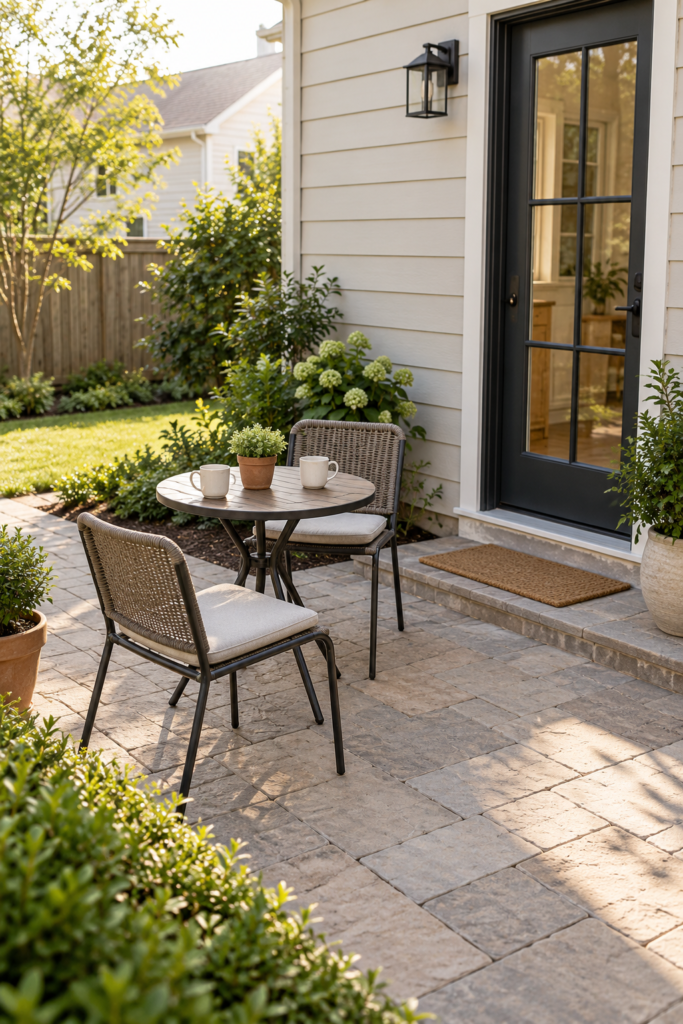
The best patio furniture for a small space is not simply the smallest table or the narrowest chair. It is the furniture that supports what you actually do outside while leaving doors, walkways, and the rest of the patio usable.
A compact table can require much more room once two chairs are pulled out. A folding set saves space only when it is easy to fold and has somewhere practical to go. A deep lounge chair may look comfortable online but consume most of a narrow patio.
Start with the activity, the number of people who use the space regularly, and the furniture’s full working footprint. Then compare comfort, materials, storage, weather care, delivery, and assembly.
Start With the Activity, Not the Furniture Set
Decide what the patio must do on an ordinary week—not during the largest gathering you can imagine.
Coffee or a Quick Meal for Two
A compact bistro table and two chairs may be enough for coffee, breakfast, or a casual meal. Before choosing one, place two dinner plates, two glasses, and any other items you normally use on a table of similar size.
A tiny tabletop can fit the patio while failing the activity. If you plan to work on a laptop, serve full meals, or use the table for plants between meals, include those needs in the test.
Lounging and Reading
If you rarely eat outside, a dining set may be the wrong starting point. Two comfortable chairs and a small side table may create a more useful space.
Lounge furniture is often deeper than dining furniture. Measure the chair in its normal position, then include legs, feet, and any reclined configuration. A chair that fits while empty may block the walkway when someone sits down.
Dining for Three or Four
A gateleg, drop-leaf, or narrow rectangular table can adapt to different group sizes. The useful question is not whether the table seats four. It is whether it seats the usual two without crowding the patio and can expand for four without blocking the door.
Occasional guests do not always justify a permanent four-seat footprint. Folding or stackable guest chairs may be more practical.
Flexible Entertaining
Stools, folding chairs, and movable side tables can support occasional gatherings without turning the patio into a furniture-storage area. Choose pieces that have a clear storage location and are light enough for the intended user to move safely.
Measure the Working Footprint
Product dimensions usually describe individual pieces. Your patio must accommodate the entire arrangement while people are using it.
The working footprint includes:
- The tabletop or seating frame.
- Every chair at the table.
- Space to pull chairs out.
- Knees and feet of seated users.
- The path people use to sit down and stand up.
- The walkway to doors, steps, gates, grills, and storage.
- The largest open or reclined configuration.
Use painter’s tape to mark the table and chair positions. Substitute existing chairs or boxes with similar dimensions. Open the house door, pull the chairs out, and walk through the area while someone is seated.
Measure the Furniture While Stored
For folding, stacking, nesting, or modular furniture, record the stored dimensions as well as the open dimensions.
Ask:
- Where will folded pieces go?
- Will the stack fit below a shelf or inside a storage area?
- Can one person carry the pieces through the door?
- Will wet furniture drip inside the house?
- Does the folded item still need protection from weather?
Furniture is not space-saving if the folded set permanently leans against the only usable wall.
Measure the Furniture in Use
Do not stop at table length and width. Include chair width and depth, the gap between seats, and the room needed to pull each chair away from the table.
Manufacturer data can reveal how different the full arrangement is from the tabletop. For example, IKEA lists one SUNDSÖ table at 25 5/8 inches square and lists the folding chairs separately at 16 7/8 inches wide and 18 1/8 inches deep. The table dimensions alone do not describe the floor area required for two seated users.
Some manufacturers publish a recommended space for the pictured set. POLYWOOD, for example, lists a 68-inch-wide recommended minimum space for one two-seat Lakeside bistro configuration, even though the included round table is substantially smaller. That figure is specific to the manufacturer’s pictured arrangement, but it demonstrates why a table diameter is not a set footprint.
Measure the Largest Configuration
Expandable furniture needs more than one outline.
Mark:
- The table fully closed.
- One leaf open, if that is a usable configuration.
- The table fully extended.
- All chairs in their occupied positions.
- Any recliner or footrest fully extended.
- The largest modular seating arrangement you realistically plan to use.
IKEA, for example, lists different minimum, standard, and maximum lengths for one ASKHOLMEN gateleg table. The important principle is broader than that product: a transforming table does not have one permanent footprint.
Choose the Right Furniture Type
Each furniture type solves a different small-space problem.
Compact Bistro Set
A two-person bistro set is a practical starting point for meals and drinks. Round tables can reduce sharp corners in a tight route, while square tables may sit neatly near a wall when not in use.
Check:
- The complete working footprint.
- Whether chairs tuck under the table.
- Table stability on the patio surface.
- Leg positions and knee clearance.
- Whether the tabletop is large enough for the intended activity.
Do not assume every set marketed for a balcony will fit every balcony.
Folding Table and Chairs
Folding furniture can return floor space when not in use. It is most useful when folding takes little effort and the stored pieces have a real destination.
Compare:
- Open and folded dimensions.
- Weight of each piece.
- Locking mechanism.
- Pinch points and operating instructions.
- Carrying grip.
- Stability when open.
- Storage and weather-care requirements.
IKEA describes its SUNDSÖ table and chairs as foldable and suitable for smaller spaces. Its care guidance also recommends regular cleaning, limiting unnecessary unprotected outdoor exposure, and allowing air to circulate when furniture is covered. Folding does not eliminate maintenance.
Gateleg or Drop-Leaf Table
A transforming table can serve two people most days and expand for guests. Measure every configuration you intend to use.
Pay attention to the leg position after each leaf moves. A larger tabletop is less useful if the support blocks a chair or eliminates knee room.
Stackable Chairs
Stackable chairs can provide guest seating without occupying a large area individually. Check the manufacturer’s stacking guidance rather than assuming unlimited stacking.
Consider:
- Maximum recommended stack.
- Height and stability of the stack.
- Combined weight.
- Whether the chairs scrape each other during stacking.
- A sheltered storage location.
Nesting or Small Side Tables
Small movable tables work well with lounge seating. Nesting designs can combine several surfaces into one storage footprint, but the pieces still need to be stable and easy to separate.
Heavy materials may create a small footprint without creating a portable table. One Article cement side-table listing, for example, shows how compact dimensions can come with substantial item weight. Always compare both.
Bench Seating
A bench can reduce the number of separate chair legs and may tuck closer to a table. However, a person seated in the middle may need others to move before standing up.
Verify the seat rating, width per person, back support, weight, and moving instructions. If the bench also provides storage, check the lid clearance and interior dimensions separately.
Modular Seating
Modular furniture is useful when you will genuinely change the layout. Before buying, draw each planned configuration and identify where unused modules will go.
Check connectors, cushion movement, gaps between modules, and the largest arrangement. A flexible system can still overwhelm a patio if every module remains outside all year.
Choose a Table Shape for the Space
Shape changes how furniture interacts with corners and walkways.
Round Tables
Round tables have no projecting corners and encourage face-to-face conversation. They still require space for chairs around the circumference. Do not use the table diameter as the full footprint.
Square Tables
A square table can align with walls, deck boards, or a patio corner. It may also be easier to push to one side when the surface is needed for another activity.
Small square tops can become crowded when serving full meals, so test the usable surface.
Narrow Rectangular Tables
A narrow rectangular table can follow a wall or railing and may support more seats along its length. Check the end-seat clearance and the walkway on both long sides.
Wall-Mounted or Half Tables
A wall-mounted folding table can minimize the floor footprint, but it transfers the structural decision to the wall and mounting system. Follow the exact product instructions and obtain appropriate help when the supporting surface or installation is uncertain.
Balance Weight, Mobility, and Stability
Light furniture is easier to fold, carry, and rearrange. Heavier furniture may feel more stable and require less frequent repositioning. Neither is automatically better.
For each piece, ask:
- Can the intended user move it safely?
- Does the manufacturer give wind or storage guidance?
- Will chair feet remain stable on deck gaps, pavers, or an outdoor rug?
- Can a heavy set be moved for cleaning or seasonal storage?
- Does delivery or assembly require two people?
Do not improvise anchors or place unapproved weights on furniture. Follow the instructions for the exact product and respond to severe weather according to manufacturer and local guidance.
Compare Materials by Care Requirements
Material names are only a starting point. Construction, finish, hardware, climate, and maintenance determine how a particular piece performs.
Powder-Coated Steel or Aluminum
Metal furniture can have a slim profile suited to tight spaces. Check coating care, corrosion guidance, drainage openings, hardware, and surface temperature in direct sun.
Inspect scratches according to the manufacturer’s instructions rather than applying an incompatible coating.
Wood
Wood can feel warmer and more furniture-like. It may require cleaning, refinishing, or sheltered storage depending on the species and finish.
Check joints, slats, feet, fasteners, and the maintenance schedule. Folding wooden furniture still needs care at hinges and moving connections.
HDPE, Resin, or Plastic
These materials can be relatively low-maintenance, but weight and construction vary widely. Some HDPE pieces are heavier than their appearance suggests.
Review UV guidance, cleaning instructions, fasteners, reinforcement, and stated load limits. POLYWOOD, for example, publishes material and care information alongside recommended space and set weight for its bistro sets. Treat those as model-specific facts.
Wicker and Fabric Components
Look beyond the visible weave. Check the underlying frame, drainage, fabric care, replacement-cover availability, and how quickly cushions can be removed.
Outdoor fabric may resist some exposure without being suitable for indefinite wet storage. Follow the care label and let cushions dry before storing them.
Plan for Rain, Wind, and Seasonal Storage
“Outdoor” does not mean maintenance-free or suitable for every exposure.
Before buying, decide:
- Which pieces remain outside.
- Which pieces move indoors during storms or winter.
- Where dry cushions will be stored.
- Whether a cover is recommended.
- How air will circulate under a cover.
- Who can move the furniture when needed.
A folding set can be useful in a seasonal climate because it occupies less storage space. But repeatedly carrying an awkward or heavy piece through a narrow doorway may discourage proper storage.
Check furniture and textile care separately. Allow wet surfaces to dry, remove debris from drainage gaps, and avoid storing damp cushions in a closed box.
Check Delivery and Assembly
A set may fit the patio after assembly but fail to fit through the route that leads there.
Measure:
- Gate and doorway width.
- Stair width and landing depth.
- Tight corners.
- Elevator dimensions, if applicable.
- Package dimensions.
- The final assembled item if it cannot be disassembled easily.
Review the number of packages, item weight, assembly time, tools, and recommended number of people. Article’s listing for one Sarek outdoor dining set, for example, separates table and bench dimensions, lists their weights, provides box dimensions, and estimates assembly time. Those details may matter as much as the finished footprint.
A Practical Furniture Selection Framework
Compare candidates using the same questions.
| Criterion | Question to answer |
|---|---|
| Primary use | Does it support the activity you do most often? |
| Working footprint | Does the full arrangement fit while occupied? |
| Walkway | Can doors and routes still function? |
| Everyday seats | Does it fit the usual number of users? |
| Flexibility | Will folding, stacking, or modularity be used in practice? |
| Comfort | Do seat dimensions and posture suit the users? |
| Care | Can you perform the required maintenance? |
| Storage | Is there a real location for cushions and folded furniture? |
| Delivery | Can every package reach the patio? |
| Evidence | Are dimensions, materials, care, and instructions documented? |
You can score each surviving option from one to five, but use exclusion criteria first. Remove any choice that blocks a required path, does not fit its working footprint, lacks critical specifications, or is unsuitable for the expected exposure.
A high total score cannot make an oversized set fit.
10 Common Small-Patio Furniture Mistakes
1. Choosing From Photos Instead of a Floor Plan
Wide-angle product photos can make an arrangement appear smaller. Use published dimensions and mark the space yourself.
2. Buying for Rare Guests
Choose for daily use and add occasional seating only when needed.
3. Measuring the Table but Forgetting the Chairs
Include pulled-out chairs, seated users, and the path behind them.
4. Choosing Lounge Furniture That Is Too Deep
Measure the chair with legs and footrests in their normal position.
5. Assuming Folding Means Easy Storage
Check folded size, weight, mechanism, and storage location.
6. Choosing the Lightest Furniture Without Considering Exposure
Mobility is useful, but stability and manufacturer guidance still matter.
7. Forgetting Cushion Storage
Plan where clean, dry cushions will go before buying them.
8. Ignoring Material Care
The finish and maintenance routine can matter more than the material category.
9. Forgetting Delivery Access
A fully assembled chair or long package may not pass a tight gate or stair turn.
10. Trusting a “Best” Label Without a Method
A useful recommendation should state the intended user, measurements, evidence, and tradeoffs.
Frequently Asked Questions
What type of patio furniture is best for a small space?
The best type depends on the primary activity. A bistro set may suit meals for two, lounge chairs may suit reading, and folding or gateleg furniture may suit a patio that changes functions. Measure the full working footprint before choosing.
How do I measure a small patio for furniture?
Mark the furniture dimensions, add chairs in their pulled-out positions, include seated users and moving parts, and preserve the necessary doors and walkways. Also measure the largest open or reclined configuration.
Is a round or square table better for a small patio?
Neither shape is always better. Round tables remove corners, while square tables can align neatly with walls. Compare the full chair arrangement and the usable tabletop for your activity.
Is folding patio furniture worth it?
It can be when you regularly reclaim the floor space and have a practical place to store the folded pieces. Check weight, folded dimensions, mechanism, comfort, stability, and care instructions.
How many chairs fit on a small patio?
Fit depends on chair dimensions, table shape, pulled-out position, users, and walkways. Do not calculate chair count from table size alone. Mock up the complete arrangement.
Should I leave patio furniture outside all year?
Follow the instructions for the exact furniture, finish, cushions, climate, and exposure. Some products recommend covers or indoor storage in certain conditions. Covered furniture may still need airflow to reduce condensation.
Choose the Smallest Set That Fully Does the Job
A successful small patio does not need the maximum number of seats. It needs enough comfortable furniture for normal use, a clear route through the space, and a realistic plan for weather and storage.
Define the main activity, mark the working footprint, and test the layout with chairs pulled out. Then compare comfort, care, weight, delivery, and the effort required to transform or store the set.
If one piece can perform two needed functions, an outdoor storage bench may be worth considering. If storage rather than seating is the real problem, solve that separately instead of forcing more furniture into the patio.
Continue With a More Specific Buying Guide
- For two-person dining, see how to choose a small outdoor bistro set.
- For furniture that moves away, compare folding patio furniture for small spaces.
- Complete the floor with an outdoor rug for a small patio.
- Add shade only after measuring the full small patio umbrella system.
- If seating and storage must share one footprint, compare outdoor storage benches.