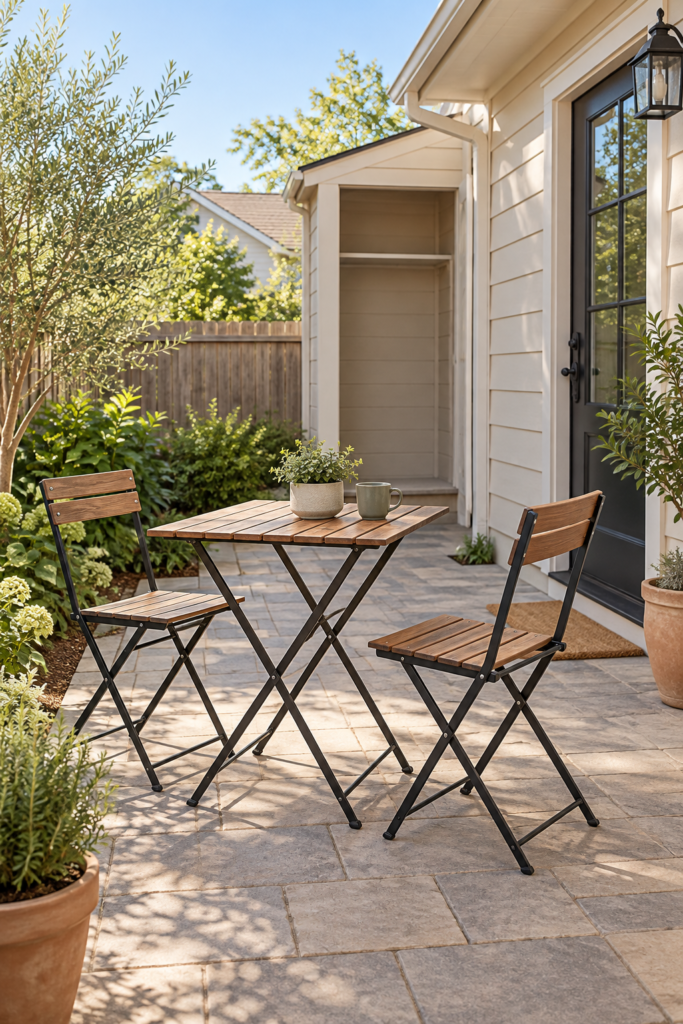
Folding patio furniture can make a small outdoor space more flexible. A table and chairs can appear for breakfast, then move away when you need an open walkway, room for children to play, or space to care for plants.
But a folding label does not automatically make furniture space-saving. Some pieces remain bulky when folded. Others are awkward to carry, difficult to lock, or uncomfortable enough that they rarely get used. A set can disappear from the patio only if you have a realistic place to put it.
The best way to compare folding furniture is to study its entire routine: open, use, fold, carry, and store. This guide walks through that routine before you spend money.
Quick Answer: What Makes Folding Patio Furniture Practical?
Practical folding furniture should meet six conditions:
- It fits the patio when fully open and occupied.
- There is enough room to open and fold it safely.
- One or two people can move it as instructed.
- The folded pieces fit an actual storage location.
- The chairs and table are comfortable enough for regular use.
- The materials and folding hardware match the expected outdoor exposure and maintenance routine.
Measure all six conditions. Do not rely on a photograph of the furniture leaning neatly against a wall.
When Folding Furniture Makes Sense
Folding furniture works especially well when one surface has several jobs.
It may suit:
- A patio that alternates between dining and open floor space.
- A balcony where chairs need to move indoors during bad weather.
- A rental where permanent installations are not appropriate.
- A household that needs extra seating only occasionally.
- A narrow route that must stay open most of the day.
- Seasonal use where furniture can be stored for part of the year.
It may be less useful when:
- There is no dry, accessible storage space.
- The user cannot comfortably lift or operate the pieces.
- The furniture will remain open almost all the time.
- Daily setup would become annoying.
- A chair’s folding design compromises comfort.
- Wind or uneven ground makes a very light piece unsuitable under the manufacturer’s guidance.
The goal is not to buy furniture that can fold. It is to choose furniture you will realistically fold when the space needs to change.
Measure Three Different Footprints
Most shoppers measure only the open table. Folding furniture requires three measurements.
1. The In-Use Footprint
Measure the table, chairs, people, chair movement, and walkway when everything is in use.
Include:
- Chair depth when someone is seated.
- Space to pull the chair away from the table.
- Door and gate swings.
- Steps and changes in level.
- Access to grills, storage, and utilities.
- Clearance around railings, planters, and walls.
Use painter’s tape and existing chairs or boxes to make a physical mock-up. Sit, stand, carry a tray, and walk through the layout.
For a full furniture-layout method, see our guide to patio furniture for small spaces.
2. The Folding Footprint
Furniture needs temporary space while it changes shape. A folding table may swing outward before its legs collapse. A chair may need to be pulled away from a wall before it closes.
Check:
- Which direction each component moves.
- Where hands must go.
- Whether the item must be tilted or turned.
- Whether another chair has to move first.
- Whether the operating area crosses a doorway or step.
Do not plan to fold furniture while balancing near a railing or standing in a blocked route.
3. The Stored Footprint
Published folded dimensions should include height, width, and depth. A chair that looks flat from the side may still have a wide frame or projecting feet.
Measure the proposed storage area and its access route. If several chairs stack or stand together, measure the complete group rather than one chair multiplied mentally.
Leave enough room to retrieve one item without unloading an entire closet.
Map the Complete Storage Route
Walk the journey from the patio to storage before ordering.
Measure:
- Door and gate openings.
- Hallway width.
- Corners and stair landings.
- The gap between furniture and walls.
- Closet, shed, garage, or deck-box openings.
- The height available if pieces stand upright.
Also note thresholds, wet floors, rugs, and stairs. An item can be compact yet awkward to carry because its weight is far from the handhold or its frame catches on doorways.
If the storage location requires lifting furniture overhead or carrying it down steep stairs, reconsider the plan. Storage is useful only when the routine is safe and convenient for the people doing it.
Check the Weight of Every Piece
Product listings sometimes state the total shipping weight but not the weight of each assembled component. For daily movement, individual weight matters more.
Look for:
- Table weight.
- Weight per chair.
- Package weight.
- Recommended number of people for moving or assembly.
- Handholds or safe gripping points described by the manufacturer.
Lightweight furniture can be easier to carry. It may also move when bumped or exposed to wind. Heavier furniture may feel more stable but defeat the purpose if nobody wants to put it away.
Do not judge weight by material name alone. Two aluminum chairs can have very different construction and mass. Use figures for the exact product.
Inspect Hinges, Locks, and Pinch Points
The folding mechanism is part of the furniture, not a minor feature.
Before buying, review the manual or manufacturer instructions for:
- The correct opening sequence.
- How the open position locks.
- How the lock releases.
- Where hands should be placed.
- Pinch or crush warnings.
- Whether fingers remain clear during operation.
- Inspection and maintenance of the mechanism.
- Replacement parts.
Never assume that a chair is secure because it appears fully open. Confirm that its locking or bracing system is in the position required by the manufacturer before sitting.
Keep children and pets away while furniture is being folded or unfolded. Do not let a child play with the mechanism or use a folded piece as climbing equipment.
If a hinge is bent, a lock no longer engages, or hardware is missing, stop using the item and follow the manufacturer’s service guidance. Do not improvise a structural repair.
Compare the Main Folding Furniture Types
Folding Bistro Sets
A small table and two folding chairs can serve coffee or meals, then move out of the way.
Check: tabletop capacity, chair comfort, folded dimensions of all three pieces, locks, weight, and whether the chairs tuck beneath the table when open.
If two-person dining is the main purpose, our small outdoor bistro set guide explains how to test the complete working footprint.
Folding Dining Tables
A folding table can provide a larger surface only when needed.
Check: open and closed lengths, leaf support, leg position, knee clearance, stability in every allowed configuration, and whether one person can operate it.
A table with several configurations needs a separate floor plan for each one you expect to use.
Folding Chairs
Separate folding chairs can supplement permanent seating for occasional guests.
Check: seat height, width, depth, back support, load limit, folded profile, carrying method, and safe stacking or storage instructions.
Do not buy extra chairs merely because they store flat. Decide where the entire quantity will go.
Folding Lounge Chairs
Lounge chairs can provide a deeper, more relaxed position but require more floor space and storage length.
Check: every approved reclining position, leg-rest movement, controls, center of gravity, getting in and out, and the fully folded size.
Drop-Leaf or Gateleg Tables
These tables reduce their surface without leaving the patio. They may work well against a wall in the closed configuration.
Check: the footprint with no leaf, one leaf, and all leaves open; leg position; support hardware; chair placement; and the manufacturer’s operating instructions.
Wall-Mounted Folding Tables
A wall-mounted table can free the floor, but installation changes the decision.
Check: whether the wall and product are compatible, mounting hardware, structural requirements, clearances, folded projection, and local or rental restrictions.
This is not a universal DIY installation. Follow the manufacturer’s instructions and use a qualified professional where the wall, hardware, or load requirements are uncertain.
Do Not Sacrifice Comfort for a Thin Fold
A very slim folded chair can still be the wrong choice if it is uncomfortable in use.
Compare:
- Seat height from the floor.
- Usable seat width and depth.
- Back height and angle.
- Position of frame bars beneath the seat.
- Armrests and their effect on table clearance.
- Cushion need and storage.
- Ease of sitting down and standing up.
Think about the longest typical sitting session. A chair used for ten-minute coffee breaks has a different comfort requirement from one used for dinner or laptop work.
Whenever possible, sit in the furniture before buying or choose a retailer with a practical return process. Measurements narrow the options, but body proportions and mobility needs vary.
Match the Furniture to the Surface
The patio surface affects stability, movement, and care.
Concrete, Pavers, or Tile
Check for uneven joints, slopes, and feet that may catch or rock. Furniture glides must be compatible with the surface and used according to the manufacturer’s instructions.
Wood or Composite Decking
Check finish compatibility, trapped moisture, scratching, heat, and the product’s guidance for feet or protective components. Do not add pads or fasteners that interfere with stability.
Gravel or Grass
Narrow legs may sink or shift. Use only furniture described as suitable for the intended surface and conditions. A flat product photo on a solid studio floor does not show performance on soft ground.
Outdoor Rugs
An outdoor rug for a small patio adds another surface layer. Check whether the folding feet or chair legs catch the rug edge, whether the rug moves, and whether water can drain and dry beneath it.
Compare Materials by Use and Maintenance
Folding joints introduce additional places where water, dirt, and wear may matter. Review care instructions for both the frame material and the mechanism.
Powder-Coated Steel
Steel may provide weight with relatively slim components. Inspect the finish, joints, fasteners, drain openings, and guidance for damaged coating or corrosion.
Aluminum
Aluminum is often easier to carry, but actual weight and stability vary. Check the finish, hardware, joint construction, and wind or storage instructions.
Wood
Wood folding furniture can look warm and compact, but hinges and moving sections still need to operate freely. Follow the exact cleaning, drying, storage, and refinishing guidance for the product.
Resin or Plastic
Check reinforcement, hinge construction, temperature limits, UV claims, cleaning methods, and whether replacement parts exist. Do not treat all molded furniture as identical.
Fabric or Sling Seats
Review drying time, cleaning, fabric tension, replacement options, and the way the material folds without being trapped or damaged.
No material is automatically suitable for year-round exposure in every climate.
Plan for Rain, Wind, and Seasonal Storage
Outdoor furniture still has operating and storage limits.
Before buying, answer:
- Must the furniture be folded or stored during wind?
- Can it be folded while wet?
- Where will it dry?
- Does a cover allow adequate ventilation?
- Can water collect inside folded frames or hollow components?
- Do cushions need separate dry storage?
- Can one person move the pieces before a storm?
- What does the manufacturer require for winter or long-term storage?
Do not assume that folding an item makes it secure in windy conditions. A folded chair leaning against a wall can still fall or move. Follow the manufacturer’s placement and storage guidance.
Furniture should be clean and dry before enclosed storage unless the instructions state otherwise. Trapped moisture can create odor, staining, corrosion, or material damage.
Check Delivery and Assembly
Some folding furniture arrives assembled; other pieces require hardware, hinges, or legs to be installed.
Review:
- Package dimensions and weight.
- Number of boxes.
- Parts and hardware list.
- Required tools.
- Number of people recommended.
- Assembly sequence.
- Initial inspection and adjustment.
- Warranty and replacement parts.
- Return process after assembly.
Measure the complete route from the delivery point to the patio and storage area. A package may be wider or heavier than the finished folded item.
Assemble furniture on a clean, stable surface and follow the instructions. Do not modify holes, braces, hinges, or locks to make pieces fit.
A Five-Step Test Before Keeping the Set
Keep packaging and follow the retailer’s return conditions while you perform a careful test.
Step 1: Inspect
Confirm that parts are present, hardware is secure, and frames, hinges, locks, seats, and finishes show no visible damage.
Step 2: Open
Follow the instructions. Note required effort, hand position, pinch points, and floor space.
Step 3: Use
Test the furniture only within its instructions and limits. Check comfort, table height, rocking, legroom, and the full walkway.
Step 4: Fold and Carry
Follow the closing sequence. Confirm the folded piece stays in the intended position and can be carried through the planned route without awkward lifting.
Step 5: Store and Retrieve
Place every piece in its real storage location, then retrieve and set it up again. If the routine is already frustrating, it is unlikely to improve with daily use.
Folding Patio Furniture Buying Checklist
- [ ] The patio’s regular activities are defined.
- [ ] Open, operating, and stored footprints are measured.
- [ ] Door, gate, stair, and hallway routes are checked.
- [ ] Weight is known for each piece, not only the shipment.
- [ ] The intended user can operate and carry each piece safely.
- [ ] Opening and closing instructions are available.
- [ ] Locks, braces, hinges, and pinch warnings are understood.
- [ ] Chairs are comfortable for the expected sitting time.
- [ ] Tabletop space supports the intended activity.
- [ ] The furniture suits the patio surface.
- [ ] Material care fits the household routine.
- [ ] Rain, wind, drying, and seasonal storage are planned.
- [ ] Cushions have separate storage if required.
- [ ] Assembly and return requirements are manageable.
- [ ] The complete set has been tested through one full open–use–fold–store cycle.
Common Mistakes to Avoid
Measuring Only the Open Table
The chairs, people, movement, and operating area often require more space.
Ignoring Folded Thickness
A tall, wide stack may not fit the closet or shed opening even when each chair looks slim.
Assuming One Person Can Carry It
Check actual individual weights and the manufacturer’s moving instructions.
Leaning Folded Furniture Anywhere
Folded pieces still need a stable, appropriate storage position where they cannot fall or block a route.
Buying Extra Chairs Without Measuring the Group
Four folded chairs require more volume and weight than one product image suggests.
Ignoring Locks and Pinch Points
Learn the correct operating sequence before regular use.
Choosing the Thinnest Chair
Comfort and support still determine whether the furniture is used.
Treating an Outdoor Label as Unlimited Exposure
Follow care, weather, and storage instructions for the specific product.
Frequently Asked Questions
Is folding patio furniture good for a small balcony?
It can be, provided the furniture fits when open, leaves a safe route, operates away from the railing or edge, and has a suitable storage location. Follow building rules and product instructions.
How should I measure folding furniture?
Measure three states: fully open and occupied, the space required while opening or closing, and fully folded in the exact storage arrangement.
Can folding patio chairs stay outside?
That depends on the exact materials, construction, finish, exposure, climate, and manufacturer guidance. “Outdoor” does not mean every product can remain uncovered in all weather.
Is lightweight patio furniture safe in wind?
Weight alone cannot answer that question. Follow the specific manufacturer’s weather, wind, use, and storage instructions. Do not improvise anchors or assume a folded item cannot move.
Are folding chairs comfortable for dining?
Some are, but compare usable seat width and depth, seat height, back support, frame position, and the expected sitting time. Try the chair when possible.
Where should I store folding patio furniture?
Use a dry, stable, accessible location that fits the complete folded dimensions and follows the manufacturer’s guidance. Keep the route clear and avoid unstable leaning or overhead lifting.
A Folding Feature Should Solve a Real Problem
Folding furniture is valuable when it allows a small patio to change jobs without making setup and storage burdensome.
Measure the open layout, the operating area, and the stored arrangement. Check every item’s weight, mechanism, comfort, materials, and care. Then test the entire routine from storage to use and back again.
If that routine is simple, the furniture can make a small outdoor space much more useful. If the routine is awkward, a compact fixed set or stackable alternative may serve you better.
For two-person dining specifically, continue with our guide to choosing a small outdoor bistro set.