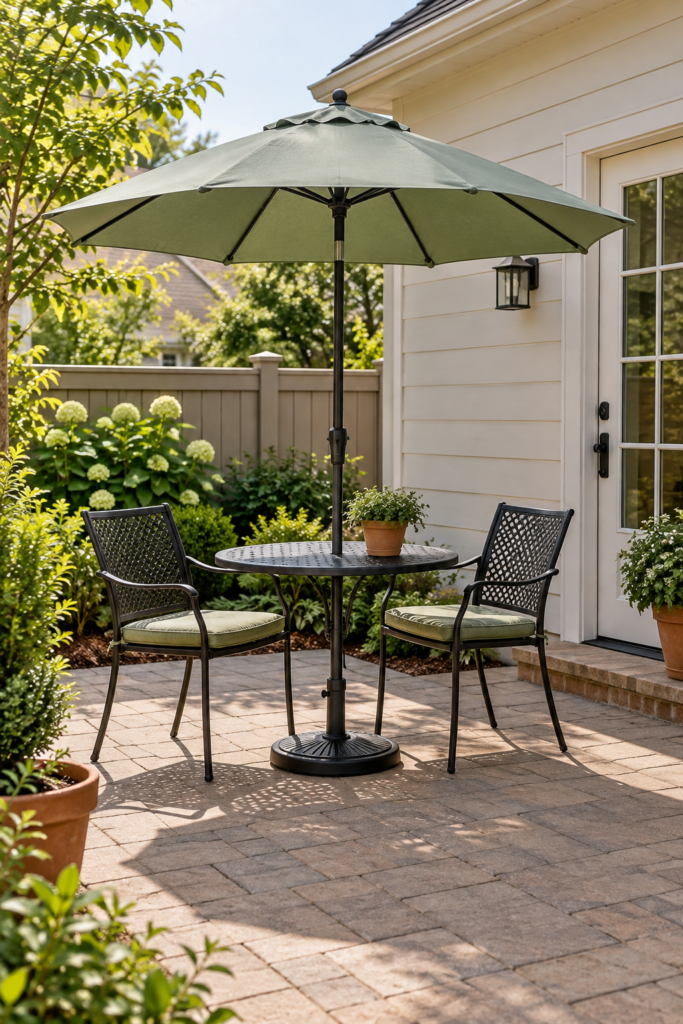
A small patio umbrella has to do more than fit above a table. It must cast useful shade without striking a wall, roof, railing, tree, or door. Its pole and base must work with the furniture, and the entire setup must follow the manufacturer’s operating and wind guidance.
The canopy diameter is only one measurement. You also need the open height, rib clearance, opening path, tilt movement, pole location, base footprint, and the route people use around it.
Start by identifying what needs shade and when. Then measure the umbrella in every position you expect to use.
Quick Answer: What Should You Check Before Buying a Small Patio Umbrella?
Check these eight areas:
- Shade target: the seats or table surface that need protection at a specific time of day.
- Open canopy: width, depth, height, and clearance from nearby objects.
- Operating space: room to open, close, crank, tilt, or rotate the umbrella.
- Pole and furniture fit: table-hole size, table clearance, and seating position.
- Base compatibility: the exact base type and weight specified for the umbrella and use.
- Wind instructions: when the manufacturer requires the umbrella to be closed, removed, or stored.
- Controls and accessibility: a user must be able to operate the mechanism safely.
- Care and storage: fabric, frame, base, cover, drying, and seasonal storage.
A smaller canopy is not automatically safer or easier to place. The complete system must suit the patio and its actual conditions.
Define the Shade Target
Decide what you are trying to shade:
- Two seats at a bistro table.
- A compact dining surface.
- One lounge chair.
- A reading area.
- A child’s supervised activity zone.
- Part of a wall-side bench.
Mark that area on a simple patio sketch. Note the hours when it is normally used.
Sun position changes during the day and across seasons. An umbrella centered over a table may shade it at midday but miss the seats in the morning or late afternoon. A tilt feature can help in some situations, but it also changes the canopy clearance and wind exposure.
Observe the location at the times that matter before choosing a canopy shape. Do not promise continuous shade based only on the umbrella diameter.
Measure the Complete Open Envelope
The open envelope is the three-dimensional space occupied by the umbrella in operation.
Record:
- Canopy width or diameter.
- Canopy depth for rectangular or half styles.
- Overall height.
- Height at the lowest canopy edge.
- Rib projection.
- Pole diameter and position.
- Base width, depth, and height.
- Tilted or rotated positions.
- Clearance needed for opening and closing.
Then mark nearby obstacles:
- Roof edges, gutters, and awnings.
- Walls, doors, and windows.
- Railings and posts.
- Tree branches and hanging planters.
- String lights and electrical fixtures.
- Grill or heat sources.
- Neighboring property and shared boundaries.
Do not let the canopy rub against or rely on another structure for support unless the manufacturer specifically designs and instructs the product for that use.
Mock Up the Umbrella Before Ordering
Use painter’s tape or removable markers to outline the base and furniture on the patio. A lightweight pole or measuring tape can help visualize the centerline and height, but do not build an improvised umbrella structure.
Test the layout with the furniture in use:
- Pull out every chair.
- Walk around the base.
- Open the door and gate.
- Carry a tray to the table.
- Sit in each position.
- Reach the umbrella control without leaning over an edge or obstacle.
- Check the view and clearance above eye level.
If the umbrella will serve a small outdoor bistro set, complete that set’s working footprint first. The umbrella base should be added to an already functional layout, not used to justify a crowded one.
Understand How Shade Moves
An umbrella blocks sunlight along the line between the sun and the target. When the sun is high, shade may stay close to the canopy. When the sun is low, the shadow moves farther to one side.
This means:
- A centered pole does not guarantee centered shade all day.
- A larger canopy may still miss a low-angle sun.
- Tilt can redirect shade but changes clearances.
- Nearby buildings and trees may already provide shade at certain hours.
Observe rather than guess. Take photos or mark the existing shadow line at several times on a clear day. Repeat seasonally if the patio’s main use changes.
An umbrella is usually best for a defined period and seating arrangement, not as a promise of full-day coverage.
Compare Common Umbrella Styles
Center-Pole Market Umbrella
A center-pole umbrella can pass through a compatible table or stand independently in an approved base.
Useful for: tables designed with an umbrella hole and symmetrical shade around the pole.
Check: pole diameter, table-hole dimensions, table clearance, base compatibility, canopy height, opening mechanism, and manufacturer wind instructions.
Small Freestanding Umbrella
A freestanding center-pole umbrella does not rely on the table for position.
Useful for: a lounge chair or furniture without an umbrella hole.
Check: the complete base footprint, trip risk, route around the pole, and whether the approved base interferes with feet or furniture.
Half Umbrella
A half-canopy design may sit near a wall and reduce outward projection.
Useful for: some narrow patios or balconies when specifically designed for that placement.
Check: dedicated base, wall clearance, canopy orientation, opening path, and whether attachment or restraint is required by the manufacturer.
Do not press a standard full umbrella against a wall and treat it as a half umbrella.
Rectangular Umbrella
A rectangular canopy may align with a narrow table or bench more efficiently than a round one.
Check: long-side clearance, orientation to the sun, rib projection, and rotation in wind.
Cantilever or Offset Umbrella
An offset pole can keep the center of a seating zone open, but the support arm and base often require more space than expected.
Check: total operating envelope, base size and filling instructions, rotation and tilt path, clearance, weight, assembly, and storage.
Even a product described as compact may be too complex for a very small patio. Measure the entire structure, not only the canopy.
Match the Umbrella to the Table
If the pole passes through a table, confirm compatibility using the exact specifications for both products.
Check:
- Umbrella-pole diameter.
- Table-hole diameter and any insert or ring.
- Clear height and structure beneath the tabletop.
- Position of table legs and supports.
- Approved base placement beneath the table.
- Clearance for the crank, pin, collar, or other controls.
- Whether the table manufacturer allows the planned umbrella system.
An umbrella hole in a table does not replace a compatible base unless the manufacturers explicitly say otherwise. The table should not be treated as the sole support by assumption.
Do not enlarge a table hole, remove structural parts, or force an incompatible pole through it.
Treat the Base as Part of the Furniture Layout
The base may use more valuable floor space than the pole suggests. It can extend beneath chairs, into a walkway, or across the place where people put their feet.
Record:
- Base width and depth or diameter.
- Base height.
- Total assembled weight.
- Whether filling is required and with what material.
- Whether wheels are included and how they lock.
- The surface on which it may be used.
- Compatibility with the exact umbrella and configuration.
Use only the base and ballast arrangement allowed by the manufacturer. Required base weight can depend on canopy size, construction, table use, and operating conditions. There is no single universal formula that makes every umbrella safe.
Do not add loose blocks, homemade weights, cords, or anchors unless the manufacturer explicitly provides an approved method. Improvised weight can shift, damage the product, obstruct the route, or create a hazard of its own.
Follow Wind Guidance for the Exact Product
No patio umbrella should be assumed safe to leave open in wind.
Read the manufacturer’s warnings and operating limits before purchase. Some instructions require closing the umbrella whenever it is unattended or when wind begins. Others may specify additional restrictions.
A vented canopy, heavy base, or marketing phrase does not make an umbrella storm-proof. Gusts are variable and site conditions can accelerate airflow near walls, corners, roofs, or between buildings.
Build a simple routine:
- Close the umbrella when it is not being used, as instructed.
- Secure any closure strap correctly.
- Remove or store the canopy or complete umbrella when required.
- Keep the route to storage clear.
- Do not operate it during unsafe conditions.
- Inspect the frame, ribs, pole, controls, base, and fabric after unusual weather.
If a component bends, cracks, loosens, or no longer operates correctly, stop using it and contact the manufacturer rather than attempting a structural repair.
Check the Opening and Tilt Mechanism
The umbrella must be easy for the intended user to operate without standing on furniture, leaning over a railing, or placing hands near moving joints.
Crank Lift
Check the crank height, turning clearance, direction, required effort, and stopping or locking process. Make sure a seated person or table accessory does not block it.
Push-Up or Manual Lift
Check the reach height, force required, pin or latch, hand position, and pinch warnings. A short user may need a different mechanism.
Pulley System
Check the rope, cleat or securing method, operating instructions, loose-line management, and maintenance. Keep cords managed around children and pets according to the manufacturer’s guidance.
Tilt Mechanism
Check how the tilt is activated, the allowed positions, clearance from nearby objects, and whether the umbrella must be closed before adjusting.
Do not force a control or operate it in a sequence not described by the manufacturer.
Compare Canopy Fabric Without Relying on Marketing Alone
Fabric affects shade, appearance, drying, cleaning, and replacement cost.
Review the manufacturer’s information for:
- Fiber content.
- UV or fade-resistance claims and their conditions.
- Water-resistance description.
- Cleaning products and methods.
- Drying requirements.
- Vent construction.
- Removable or replaceable canopy.
- Warranty coverage and exclusions.
Water-resistant does not mean the umbrella should remain open in rain or stored while wet. UV-resistant does not mean the color will never change.
Dark fabrics may appear to cast deeper shade but can also become warm. Light fabrics may show stains differently. Choose color only after compatibility, operation, and care are understood.
Compare Frame and Pole Materials
Material names do not determine performance by themselves. Construction, finish, joints, ribs, fasteners, controls, and maintenance all matter.
Aluminum
Often relatively light, but actual product weight and strength vary. Check finish care, connectors, corrosion guidance, and compatible base requirements.
Steel
May add weight, but coatings, joints, scratches, drain points, and corrosion still require attention. Follow the exact care instructions.
Wood
Wood can suit a traditional style but may require specific cleaning, drying, refinishing, and storage. Check how the lift and pin system works before buying.
Fiberglass or Composite Ribs
These may flex differently from metal ribs. Use manufacturer specifications rather than assuming flexibility makes the umbrella wind-safe.
No frame material removes the need to close and store the umbrella as directed.
Plan Delivery, Assembly, and Filling
Umbrella components can be long, heavy, or delivered in several packages. A base may be particularly difficult to move after it is filled.
Before ordering, check:
- Package length, width, height, and weight.
- Number of packages.
- Complete parts list.
- Tools and number of people required.
- Where assembly must occur.
- Whether a fillable base should be filled only in its final position.
- The approved fill material and quantity.
- Drain or emptying procedure.
- Return process after assembly or filling.
Measure gates, doors, corridors, stair turns, elevators, and the final storage route. Do not fill a base somewhere that makes it impossible to move safely afterward.
Follow the instructions for assembly and tightening. Do not drill new holes, substitute structural hardware, or combine parts from unrelated systems.
Plan Storage Before the First Storm
Decide where the closed umbrella, canopy, pole, and base will go.
Measure:
- Closed umbrella length and width.
- Storage bag or cover size.
- Door and stair clearances.
- Shelf or floor position.
- Base weight when filled.
- Space for a removable canopy.
Clean and dry the umbrella according to instructions before long-term storage. Do not enclose wet fabric or place a long umbrella where it can fall into a route.
If the base must be emptied, learn the procedure before choosing the fill material. Some filled bases may be impractical for seasonal movement.
Coordinate the Umbrella With the Rug and Lighting
An outdoor rug for a small patio changes drainage, base contact, and trip edges. Do not place a base on a rug unless the relevant manufacturers permit that arrangement and the complete setup remains stable.
Overhead string lights, wall fixtures, and cords must remain clear of the canopy and opening path. Plan evening use with our cozy backyard lighting ideas guide, but never attach lights to an umbrella unless the product is designed and instructed for them.
Every new accessory changes the original footprint. Recheck doors, chair movement, and walking routes after each addition.
Small Patio Umbrella Buying Checklist
- [ ] The exact shade target and main time of use are defined.
- [ ] Sun and existing shadows have been observed.
- [ ] Canopy, height, ribs, pole, base, and operating envelope are measured.
- [ ] Roofs, walls, railings, trees, doors, lights, and utilities remain clear.
- [ ] Furniture works before the umbrella is added.
- [ ] Pole, table hole, table structure, and base are compatible.
- [ ] The approved base fits without blocking feet or walkways.
- [ ] Manufacturer wind and unattended-use instructions are understood.
- [ ] The intended user can reach and operate all controls safely.
- [ ] Tilt or rotation remains clear in every approved position.
- [ ] Canopy fabric and frame care match the household routine.
- [ ] Packages fit through the delivery route.
- [ ] Assembly and base filling can occur safely.
- [ ] A realistic closing and storage routine is ready.
- [ ] Warranty, replacement canopy, parts, and returns are understood.
Common Mistakes to Avoid
Choosing by Canopy Diameter Alone
Measure the pole, base, height, ribs, controls, and movement as one system.
Assuming the Shadow Stays Under the Canopy
Sun angle changes the location and shape of the shade.
Treating the Table as the Base
Use the exact compatible support system required by the manufacturers.
Buying an Oversized Base Without Mapping the Floor
A base can remove legroom or block the only safe route.
Using a Generic Base-Weight Formula
Compatibility and required support depend on the exact umbrella, base, configuration, and instructions.
Leaving the Umbrella Open and Unattended
Follow the product’s closing and wind instructions every time.
Operating the Mechanism From an Unsafe Position
Choose controls that the intended user can reach from stable ground.
Forgetting Where the Filled Base Will Go
Plan assembly, filling, movement, draining, and seasonal storage before ordering.
Frequently Asked Questions
What size umbrella is best for a small patio?
There is no universal best diameter. Choose a canopy that shades the intended seats at the relevant time while maintaining full clearance, compatible support, and a usable walking route.
Can I put a patio umbrella through any table with a hole?
No. Compare the pole diameter, table-hole dimensions, structure beneath the tabletop, controls, and base requirements for both products. An umbrella hole alone does not prove full compatibility.
Does a patio table hold an umbrella without a base?
Do not assume it does. Use the base and support arrangement specified by the umbrella and table manufacturers.
How heavy should a patio umbrella base be?
Use the requirement for the exact umbrella, base, table or freestanding configuration, and operating conditions. A general number cannot guarantee safe use across different products.
Is a half umbrella good for a small balcony?
It may reduce projection when specifically designed for that location, but you must still check the dedicated base, canopy movement, wall and railing clearance, building rules, and manufacturer instructions.
Can I leave a patio umbrella open in light wind?
Follow the exact manufacturer guidance. Conditions and gusts can change quickly, and a heavy base or vented canopy does not make an umbrella safe in every wind.
Can a patio umbrella stay outside all year?
That depends on the product, climate, exposure, and manufacturer’s care and storage instructions. Long-term outdoor exposure is not guaranteed by the word outdoor alone.
Should an umbrella base sit on an outdoor rug?
Only if the umbrella, base, rug, and patio-surface guidance allow it and the arrangement remains stable, dry, and free of trip hazards. Otherwise, keep the base directly on an approved surface.
Choose a Complete Shade System, Not Just a Canopy
The right small patio umbrella provides useful shade while fitting safely into the full furniture layout. That requires more than choosing a pleasing color and compact diameter.
Define the shade target. Observe the sun. Measure the complete open and operating envelope. Confirm the pole, table, base, controls, and storage routine as one compatible system. Most importantly, follow the exact wind and closing instructions every time.
A modest umbrella that is easy to close and store may be more useful than a larger one that crowds the patio or becomes difficult to manage.
Return to the patio furniture for small spaces guide to confirm the complete seating and walking layout before selecting any shade accessory.